Showing posts with label Book review. Show all posts

Tuesday, 31 December 2013

2013: Reading Round-up


I have written blog posts about 32 books this year (14 non-fiction and 18 fiction which includes short story collections). In total I have read forty-five books and failed to finish another ten, which is probably about average for me. The books I have blogged about were all written by British, American or French authors, so one of my goals for blogging in 2014 is to write about books written by authors from other parts of the world.

Favourite Fiction 

Maybe you can tell from the enthusiastic postings that Emile Zola's Germinal was my favourite novel of the year. I read two Zola books as part of the Zoladdiction event hosted by Fanda and enjoyed both of them. 

Favourite Non-fiction

My best non-fiction read of the year was Anne Fadiman's At Large and at Small: Confessions of a literary hedonist which I read back in March. I didn't blog about this collection of essays here, but I am planning to reread this again in 2014 so will write about it then. I actually ended up reading this as Ex Libris: Confessions of a common reader was missing (maybe it's so good someone stole it?) from the library when I tried to borrow it, I plan to read this in 2014 too.

Off-blog Reading

I have read quite a lot of Scandi noir this year. I am probably rather late in discovering this crime fiction trend, but being behind the times hasn't dampened my enthusiasm for snowy landscapes and depressed, middle-aged detectives. 

At the beginning of 2013 I watched both series of the Swedish production of Wallander with Krister Henriksson, so I began by reading a few of Henning Mankell's novels. The other  Swedish authors I read were Maj Sjowall and Per Wahloo and Stieg Larsson. 

A few months ago I discovered the Icelanders: Arnaldur Indridason and Yrsa Sirgurdardottir (both of these surnames are written with an eth: the fifth letter of the Icelandic alphabet, but I don't know how to insert it with Blogger - sorry Icelanders, Faroese and Anglo-Saxons). I don't think I have ever read Icelandic literature translated in English before, and in fact, apart from hot springs, volcanic eruptions and banking crises, I know very little about Iceland. In these novels, history doesn't stay in the past and in the four books I have read so far,  secrets and  hidden crimes resurface after many years causing death and destruction for the modern day players of the stories.


2013 has also seen me experiencing cyberpunk for the first time. I planned to read Neal Stephenson's Snow Crash and William Gibson's Neuromancer choosing these as archetypal works of the genre. After looking on my local library's shelves, I ended up with Stephenson's The Diamond Age and Gibson's Pattern Recognition.

Pattern Recognition was not what I was expecting at all. I thought it would be set in the (near-ish) future and would feature lots of discussions around computer science and artificial intelligence. It didn't. The book is set in 2002 and in a pre-Twitter and pre-YouTube world feels rather dated. The central character, Cayce Pollard, is a cool-hunter who consults for multi-nationals and advertising firms about the latest trends. The book is a fast-paced thriller set in London, Russia and Japan and it was a real page-turner which I finished in about two days. However, certain elements of the plot and characterisation, in particular, annoyed me - Cayce suffers from an anxiety disorder brought on by certain logos: nausea brought on by Prada and Louis Vuitton. I wouldn't have thought that such a "disorder" would be much of a problem. Now, if it was Primark that would be another story. 

I will consider reading another William Gibson novel as I found Pattern Recognition a bit cheap-thrillerish, so I think his other works will probably be quite fun and not take too long to read.

The Diamond Age was probably the most difficult book I read this year. It had a highly complex plot with a lot of moving around in the timing of events (making it a bit difficult to keep track of where I was) and in depth discussions of Turing machines, nanotechnology, societal groupings and collective consciousness. Although I struggled with this novel, I still plan to read Snow Crash, as Neal Stephenson's writing deals with some really interesting discussions about the use of technology in society.

Saturday, 7 September 2013

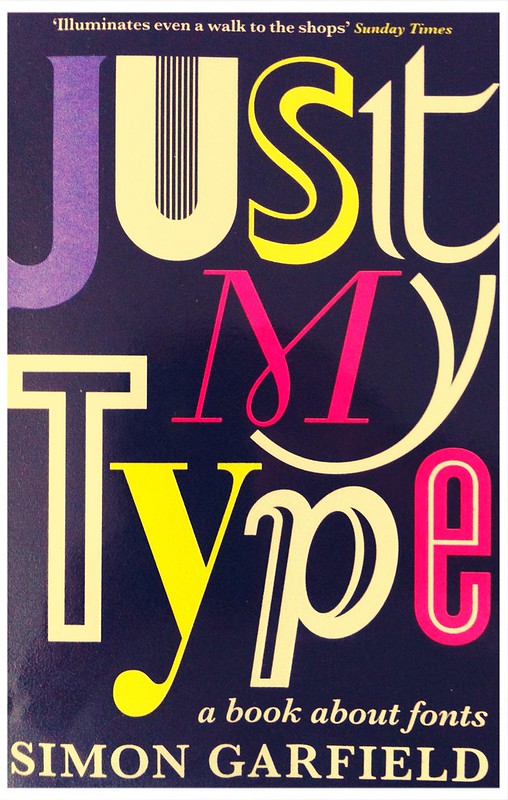
Just My Type: A Book About Fonts by Simon Garfield


There is a serendipitous satisfaction in enjoying a book which found you rather than you searching it out. A while ago I was at the library browsing in the section where I expected to find the 745.6 classmark (calligraphy). Even though my local library holds just four or five books on calligraphy I was surprised that I couldn't find any of the books on the shelf even though the catalogue said they were in the library*. Just My Type jumped out at me with it's striking cover and subtitle, "A Book About Fonts" and although it wasn't what I was looking for I thought I would give it a try.

Before reading this book I can't say that I thought about fonts much apart from choosing which fonts to use for my blog (the main script is Arial - not much thought there then, as this is the font I use for nearly all my computer produced texts - and the blog title and post titles are in Dancing Script which Google Fonts advise using "when you want a friendly, informal and spontaneous look". I wasn't aiming for spontaneity, just a contrast and, yes, I am a sucker for cheesy brush script pretending it's hand written and not really type.

Simon Garfield's survey of fonts deals with: the history of popular typefaces: Garamond, Gill Sans, Times New Roman, Baskerville, biographies of famous type designers: Lucas De Groot, Adrian Frutiger, Eric Gill, Matthew Carter, Margaret Calvert (the designer of Calvert, the font used on the Tyne and Wear Metro), the history and job of type foundries and how the innovations of the digital age have changed the nature of type designing and our relationship with type, "Computers have rendered us all gods of type, a privilege we could never have anticipated in the age of the typewriter."

This book made me look around a lot more at signs (road signs, street signs, shop signs) and think about the form of what I was looking at and not just the content.  I have also been paying more attention to the form of the books and magazines that I read. I picked up ten books from my shelves at home and was disappointed to find that only three out of these ten books credited the font on the copyright page. The fonts used were: Giovanni Book (designed by Robert Slimbach in 1989), Granjon an old-style serif typeface from 1928-29 and a similar typeface, Ehrhardt from 1938. I also had a look at my Oxford English Dictionary which uses Swift (a sans-serif from 1985) and Arial (1982) presumably for legibility.

I haven't read any of Simon Garfield's work before, but based on my experience with this book - an entertaining, witty and fascinating introduction to a subject about which I knew very little - I hope to read more of his work. He is a rather prolific non-fiction author, so there are lots of other titles from which I can choose.

Oh interrobang, how had I never seen or heard of you before? Okay, it's not a font, just a single character, but the interrobang is one of the fun little factoids that I will be taking away from Just My Type.  If you too want to represent quizzical surprise then input Alt + 8253 in Microsoft Word.


* The calligraphy books had been moved to a separate Arts and Crafts section in the area of the library which houses the "popular" books: Home and Gardens, Family, Health, Cooking. I hate it when the library is arranged like this; please, when using Dewey just start at the beginning and progress in a systematic order, it makes it so much easier to find items.

Sunday, 18 August 2013

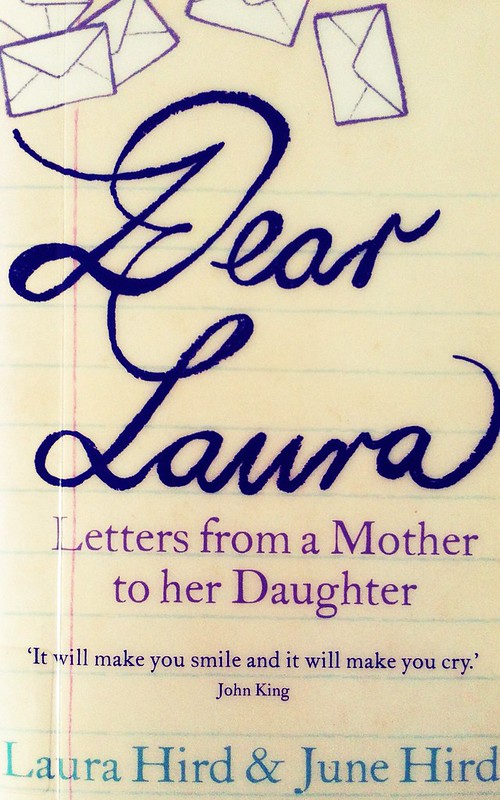
A Life in Letters - Dear Laura: Letters from a Mother to her Daughter

Dear Laura: Letters from a Mother to her Daughter - Laura Hird & June Hird


Elizabeth Chatwin, the widow of Bruce Chatwin said, "letters are the most vivid writing" and in reference to the book I read this week, I would certainly agree. The letters which fill Dear Laura are full of wit, sentimentality, sometimes admonishing, full of gossip and quotidian banalities, but always vivid and entertaining.

The majority of letters in Dear Laura cover the years 1988 - 1991, when, at the age of twenty-one, Laura Hird left her working-class home in Edinburgh to attend university in London. All bar one of the letters are from June to her daughter.

Laura is an only child, and despite a sometimes fraught relationship, the bond between daughter and mother is an incredibly close one. After signing off one of her letters, June writes "till midnight" as before leaving home Laura and her mother had agreed that every night at midnight, even though they will be 400 miles apart, they will think of each other and send good "vibrations" to each other. They also send a plastic, lucky horseshoe back and forth depending on who needs the most luck at any particular time, which reveals as much about Scottish culture as it does about the love and support mother and daughter show each other.

I can't say that I found the twenty-one year old Laura a particularly sympathetic character. In the letters she comes across as incredibly spoiled and struggling to survive her entry into independent adulthood after a sheltered childhood. Her mother often sends stamped addressed envelopes to London along with her own letters, which contain thank you notes for various friends and relatives who have sent Laura money or birthday cards and presents and all Laura has to do is pop them in a postbox in London, so they have the required postmark. In one letter June describes visiting Nannie an elderly relative who, "was in tears today about the beautiful letter you didn't write for her birthday fiver. It had pride of place on her sideboard and she made me sit and read the letter I had written, while she wept at how sweet you were."

June Hird is an accomplished letter writer (with the added ability of forging thank-you notes!) having had plenty of practice. At the end of one of her letters she says, "I must stop. I have 6 more letters to write." When was the last time you wrote one letter, let alone seven in one day? Her letters are often funny whether relating anecdotes of her daily life in Edinburgh or just expressing her thoughts. I was particularly amused by a discussion on the merits of coloured writing paper.
"Why is it healthy to write on technicoloured notepaper? - well according to a TV programme last week bleached paper contains the deadly poison dioxin. Tea bags, coffee filter paper, white tissues and toilet paper, disposable nappies and tampons, and notepapers are all suspect. Only recycled paper is safe.
Who wants to write a letter on a recycled tampon, toilet roll or nappy? Even if one does tend to write a lot of verbal diarrhoea, one doesn't need to have one's nose rubbed in it as a punishment. Thought-provoking, isn't it?"
If you are looking for a memoir about the relationships between mothers and daughters, read this book. However, don't be tricked into expecting a heartwarming tale of sentimentality, this is also a great read for anyone interested in late 1980s, early 1990s Britain: polytechnics, poll-tax riots, Margaret Thatcher and classic TV (I'd forgotten all about Lilo Lil from Bread). Dear Laura is a fascinating, easy-to-read piece of social history and a beautiful tribute to Laura Hird's parents.


Sunday, 28 July 2013

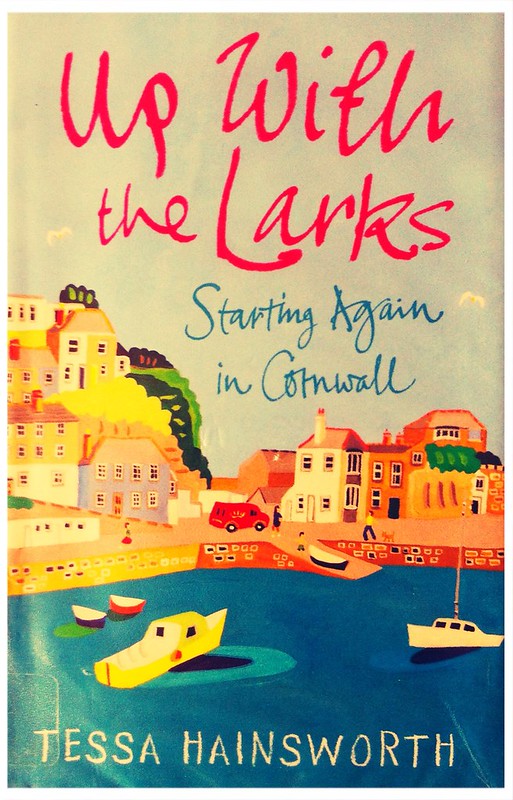
A Life in Letters - Up With the Larks: Starting Again in Cornwall

Up With the Larks: Starting Again in Cornwall - Tessa Hainsworth


I mentioned in my introductory post to A Life in Letters, that I would be reading a wide range of books related to letters and letter writing. This week instead of reading a collection of letters I read a memoir about a letter collector, i.e. the postman, in this case, a postwoman.

Up With the Larks tells the story of Tessa Hainsworth and her family as they adjust to life in a small seaside village. Tessa Hainsworth leaves her high-powered job in London and in an escape from the rat race, moves, with her husband and two young children, to South Cornwall. 

The book charts their struggles to keep financially afloat after their initial business plan designed to provide their livelihood in Cornwall collapses,
"Our golden dream was slowly turning to dust as we worried ourselves sick night after night. By this time we didn't even know if we could afford to move back to London, where we could at least find work."
Forced to find jobs, Tessa and her husband apply for everything from receptionist to taxi driver and supermarket assistant manager. Her husband ends up working multiple part-time jobs and Tessa, much to the surprise of her friends and family, gets a job with Royal Mail delivering the post.

Tessa is initiated into the life of a postwoman during the busy pre-Christmas delivery weeks by barking dogs, savage cats and suspicious locals. Ms Hainsworth's storytelling is both witty and engaging and the parts of the memoir that deal with her daily round and the lives of her customers (particularly the sympathetic descriptions of elderly Mr Hawker and the B&B owners Martin and Emma) make this book an enjoyable read.

There were elements of the writing that made me squirm in my seat and think that the book could have done with more strident editing. On its third appearance, I was thoroughly fed up with the figurative use of clotted cream, e.g. "one minute as thick as clotted cream and the next sparring with each other". Also, when her husband returns from providing a massage at the local, upmarket hotel she says, "I hope it was a rich Eastern European princess who was so thrilled by your exquisite application of healing oils and massage that she gave you a huge tip". Shouldn't that be Middle Eastern princess? I think you would be hard-pressed to find an Eastern European princess anywhere, let alone in Cornwall.  

Despite these pedantic niggles, I did enjoy this quick and easy read. Tessa Hainsworth's memoir must have enjoyed a measure of commercial success, as since the publication of Up With The Larks  in 2009 a further two books (Seagulls in The Attic and Home to Roost) about village life on the Roseland peninsula have been published.


Sunday, 21 July 2013

A Life in Letters - The Letters of Vincent Van Gogh, Part Two

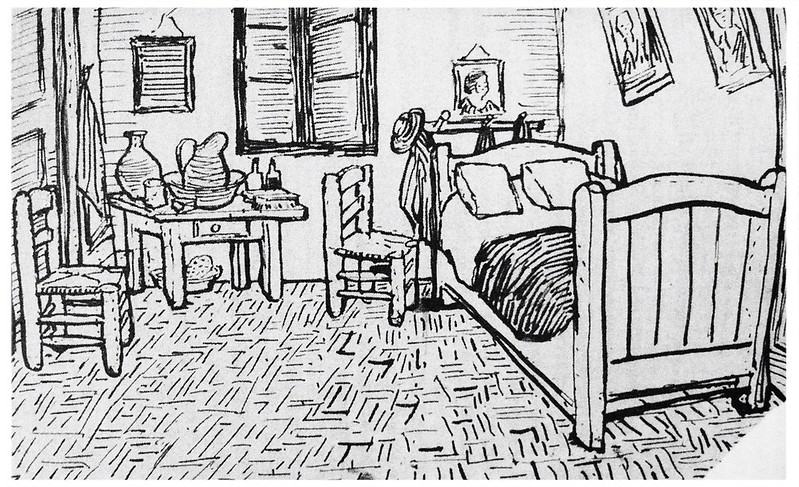
Enclosed sketch from a letter dated 16th October 1888.

I finished The Letters of Vincent Van Gogh this week and, I think I may have found a contender for my book of the year. 

Vincent Van Gogh's letters have been fascinating to read and have really changed any preconceived ideas I may have had about the great artist. I didn't really know that much about Van Gogh before I picked up this book - I love some of his paintings, but I had the general idea that he was a madman who cut off his ear and eventually committed suicide.

Reading these letters showed me a man who was dedicated to the creation of art and who longed for close relationships and a family, but who faced obstacles (poor health and poverty) in the pursuit of both of these goals. 

The letters in the second half of the book detail Vincent's disputes with his mother and father and the strain that this puts on his relationship with his brother Theo (to whom most of the letters are addressed). The close relationship which the Van Gogh brothers clearly had is one of the elements of the letters that attracted me when I started to read the book. That their relationship is sometimes strained is understandable when you take into account that Theo more or less supported Vincent throughout his adult life by sending him money to live and buy painting equipment.

Van Gogh's father died suddenly in March 1885 and from that time Vincent's relationship with his family (his mother and sisters) seemed slightly better. However, he still felt frustrated with Theo (an art dealer) who did not seem able, or willing, to sell any of his work neither as a professional nor in an individual capacity. 

In November 1885 Vincent moved to Antwerp to attend lessens at the Antwerp Academy, although at that time he began to have the idea that a move to Paris and the ability to study the works in the Louvre and the Musée du Luxembourg would benefit his artistic progression. He discusses a move to Paris with Theo, but before any definite plans can be made he takes any mutual decision-making out of Theo's hands by turning up in Paris in March 1886.

The fertile Parisian period of Van Gogh's life when he came into contact with Impressionism for the first time, met many artists (including: Toulouse-Lautrec, Paul Signac, Emile Barnard) and developed his style significantly is not well covered in his letters. He shared an apartment with Theo, so they did not need to write to each other.

Vincent's Parisian period ended in February 1888 when he arrived in Arles, Provence. These letters were some of the most interesting, for me, when Vincent is full of ideas for his artist's union (a concept he developed which was designed to provide artists with a measure of financial security), his excitement at all the subjects available to paint in the surrounding area, his improving health and artistic development, notably in his fascination with colour theory.

The final letter in the collection does not feel like a goodbye as it contains Vincent's customary order for more paints. Nevertheless, on the 27th July Vincent shot himself and died two days later in his brother's arms.

Instead of finishing this post with Vincent's death I will leave you with a quotation about technique and the creation of art (I wrote out so many little snippets as I was reading, but this is one of my favourites),
"That art is something which, though produced by human hands, is not wrought by hands alone, but wells up from a deeper source, from man's soul, while much of the proficiency and technical expertise associated with art reminds me of what would be called self-righteousness in religion."

If you can't wait for a trip to your local library to pick up the Letters, or if you really want to read more right now, you can do so online at this fabulous resource www.vangoghletters.org

Sunday, 14 July 2013

A Life in Letters - The Letters of Vincent Van Gogh

The Letters of Vincent Van Gogh


I am only half way through this collection (it is 500 pages long, so I will probably do a review of the second half next week). Although I have been slow with my reading this week it is not because this is a difficult read, in fact, quite the opposite. This is a collection to be savoured as, among other talents, Van Gogh was a fantastic letter writer.

The collection almost feels like a diary rather than letters as they are very personal and we only have one side of the correspondence. The book is filled, in the main, with Vincent's letters to his younger brother Theo, who must have been quite a hoarder as it seems that he kept every letter he received. There is at least one letter from Theo in the collection, but we only have that as Vincent sent the letter back to his brother with numbers in the margins as a time expedient way of responding to his brother's criticisms (Vincent had just had a blazing row with his mother and father and been thrown out of the house).

The letters start three years after Vincent began working at the art dealers Goupil & Cie. He begins his career in the Hague and then is transferred to the London branch in June 1873. Vincent eventually loses his job with the art dealers and spends some time working as a teacher before returning to the Netherlands and working in a bookshop. This period, when he loses his job in London and returns to the Netherlands to work in a bookshop, is Vincent's religious period and his letters are full of his plans to follow his father into his noble position as a clergyman. During a period working as an evangelist in a mining village in Belgium, Vincent decides to become an artist. The letters have not been as full of art as I would have expected (he mentions his predilection for Ingres paper (a type of drawing paper), live models for his drawings and the problems of finding a suitable studio), but I think that the focus on art and painting will increase in the second half of the collection, now that he has abandoned his religious leanings and his infatuation with his cousin Kee Vos.

Almost thirty pages of the book are taken up by Vincent's love problems. He falls violently in love with his widowed cousin Kee, who tells him that she could never be with him. Despite this setback, Vincent continues to ask her father for her hand in marriage and the letters of this period detail his perseverance in the face of adversity and his family's increasing discomfort in the face of his obsession.

These letters seem to contain all sorts of thoughts and feelings that many others might choose to write in a diary rather than in a letter. Vincent seemed to recognise the dramatic and revelatory nature of his letters, as in one letter he writes,
"Write to me soon and try to separate the wheat from the chaff in my letters. If there is some good in them, some truth, tant mieux,* but there is, of course, much in them that is more or less wrong or exaggerated perhaps, without my always being aware of it."
* So much the better.

It is this, I suppose, that makes the letters so readable.


Sunday, 7 July 2013

A Life in Letters - Dear Friend & Gardener

Dear Friend & Gardener: Letters on Life and Gardening by Beth Chatto and Christopher Lloyd


This is the first post for my Sundays in summer theme: A Life in Letters.

Dear Friend & Gardener is slightly unusual for a letter collection between two correspondents as it was published, in 1998, whilst both writers were still alive (Christopher Lloyd died in 2006). As both Christopher Lloyd and Beth Chatto are very popular garden writers, I suppose the publisher thought that a series of letters written by the two friends, over the space of two years (1996 and 1997), about gardening and their wider lives would sell well.

The letters didn't feel particularly contrived when I read them, and as Christopher Dixter writes in his last letter of the series,
"The main difference, from a totally private letter, is the extra explanatory matter that is necessary, as, in this letter, 'the autumn-flowering Crocus speciosus'. Obviously, 'autumn-flowering' would be omitted in a wholly private letter, as we both know this perfectly well. Apart from that, perhaps the odd indiscretion had to be foregone, but nothing much."
Perhaps, "the odd indiscretion" would have made the collection more thrilling to read, but I was happy enough with Chatto and Lloyd's discussions on plants, planting trends, fellow horticulturalists and horticultural students, the vagaries of the English weather, reminiscences of previous lecture tours they had taken together,  health problems, Glyndebourne and opera, family and friends and from Christopher Lloyd lots of news about Fergus (Fergus Garrett is now head-gardener at Great Dixter).

In addition to singing Fergus' praises in nearly every letter, Christopher Dixter also mentions his dogs a lot. Canna, in particular, gets plenty of mention in his letters, probably because at the beginning of the collection she is only about 6 months old and is not fully trained (or, perhaps she is, and she is just naughty). Some of his comments on Canna's behaviour were really quite disgusting: "Canna greeted me effusively, when I called the dogs, early this morning. That is ominous. She usually lies in bed. Sure enough, she had left me a 'present'. After I had rubbed her nose in it, she knew that that was over, and was effusively affectionate." He is obviously very attached to his "girls" as he calls them, and his letters see him relaxing on a sofa with the dogs alongside his right leg and sitting in the garden with his dogs at his side.

If you like gardening then this letter collection is definitely for you. However, if you have a passing interest in gardening but like to read about genteel days gone by then this collection would also appeal to you. There was something quite touching about these letters written by two (sometimes quite opinionated) experts in their field who were facing the challenge of dealing with the constrictions of aging bodies, if not, minds.


Saturday, 6 July 2013

Summer Recess - A Life in Letters

A Life in Letters


Much as I am enjoying reading a short story, or a whole collection, every week,  I decided to have a change of theme for Sundays in the summer: The Library File's summer recess.

Throughout July and August I will be reading letter collections or books associated with letter writing and posting about what I have read on Sundays. I flirted with the idea of naming this theme "Literary Letters on a Sunday"; however, when it came to sourcing books from the library to read I discovered that some of the collections I was really interested in were not written by literary figures, so most of the books I will be blogging about will be literary letters but with a sprinkling of something else too.

If you have written a review of a letter collection please feel free to put a link to your blog post in the comments section of my Sunday posts.

Short Story Sunday will return in September.

Sunday, 30 June 2013

Short Story Sunday - Michel Faber

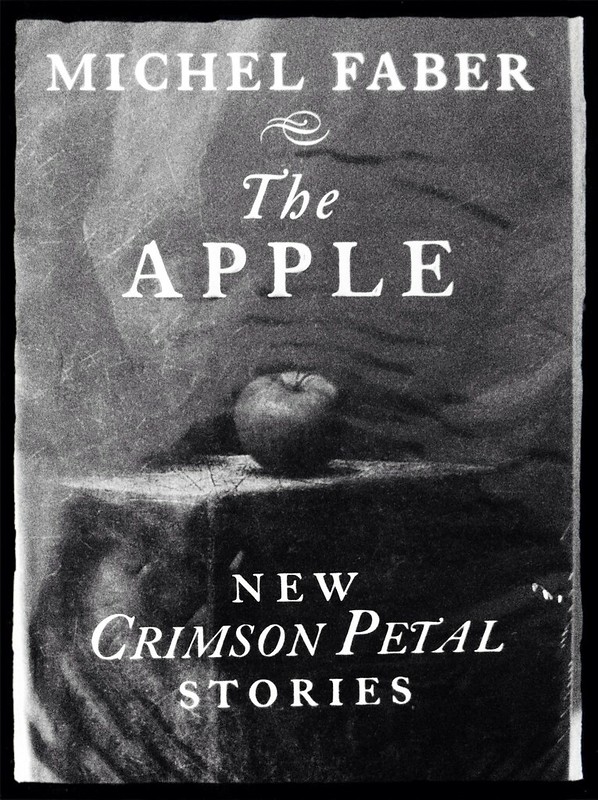
The Apple - Michel Faber


Michel Faber's collection of short stories, The Apple, is subtitled Crimson Petal Stories as many of the characters that first make their appearance in Faber's novel published in 2002, The Crimson Petal and the White, reappear in this collection. I have not actually read the novel about Sugar, a young woman who works as a prostitute in Victorian London, but as the author notes in the foreword to this collection, you don't need to have read the novel to appreciate this collection, "The stories are, as stories should be, little worlds of their own."

The Apple contains seven stories in 199 pages:
  • Christmas in Silver Street
  • Clara and the Rat Man
  • Chocolate Hearts from the New World
  • The Fly, and its Effect upon Mr Bodley
  • The Apple
  • Medicine
  • A Mighty Horde of Women in Very Big Hats, Advancing
It took me no time at all to finish reading the collection, and every story pulled me in to the action, fascinated and entertained me and impelled me to continue reading. This is not to say, however, that I liked all of the stories; some of the stories came across as unnecessarily crude and made me feel quite peculiar. I read the whole thing in two sittings, but that was more due to time constraints than anything else, as this is the sort of book that you could read in one go if you had a couple of hours free.

The two stand-out stories for me were Chocolate Hearts from the New World and A Mighty Horde of Women in Very Big Hats, Advancing. I think that the second story is probably the favourite of fans of The Crimson Petal and the White as the narrator of the story is Sophie's (the little girl from the novel) six year old son and as such constitutes a continuation of the Sugar saga as readers discover what happens to Sophie as an adult. The story follows the arrival of Sophie's family in London where they have returned after living in Australia for several years. Her son's impressions of life in England after his wild and free childhood in Australia and his comments about his bohemian parents are most amusing and although this is the longest story in the collection (64 pages) I was quite sad when it ended.

Chocolate Hearts from the New World describes a father's frustrations with and fears for his daughter Emmeline. Dr Curlew is worried that his teenage daughter will leave marriage too late as "The same physical features that made him such a distinguished looking man - tall, rangy build, aquiline nose, long face, strong jaw - were a calamitous inheritance for a girl." Despite Emmeline announcing that she does not want to get married, her father hopes that she will find a suitor when he learns that she writes to many men around the world. Most of Emmeline's letters go unanswered however, as her letters are missives on the subject of slavery and she mainly writes to cotton plantation owners in the United States urging them to turn their back on slavery and allow their hearts "to be penetrated by the love of Christ". Most of the responses she receives to her letters take the form of a rebuke, 
"I will thank you to keep your ignorant and impudent babblings to yourself, said one. Has it occurred to you, Miss, said another, that the very clothes you are wearing as you pen your imperious missive may have their origins in my cotton fields?"
The story of Emmeline and her father, like the other stories in this collection, is realistic, subtly-crafted and features witty dialogue.


Sunday, 23 June 2013

Short Story Sunday - Victoria Hislop

The Last Dance and Other Stories - Victoria Hislop


Victoria Hislop's collection of stories was published in 2012 and features ten stories:
  • The Priest and the Parrot
  • The Kafenion
  • Aflame in Athens
  • The Zacharoplasteion
  • The Periptero
  • One Cretan Evening
  • The Butcher of Karapoli
  • The Lesson
  • The Pine Tree
  • The Last Dance
Each story features an illustration on its title page by British illustrator Quinton Winter (what a fabulous name!). Do you like/dislike illustrations in books, or are you indifferent? I don't really care for illustrations in novels, but I absolutely love them in short fiction. Placed on the title page, illustrations make a collection very easy to navigate and encourage me to think about the story in a more visual sense (I usually focus on plot and dialogue with descriptions taking a secondary role). I don't usually look at them before reading the story, but I always return to look when I finish reading; it's interesting to see what the focus of the illustration is and whether there is any cross-over between the mental images that the story created for me and the images that the illustrator, in conjunction with the author or editor, chose to create for the story.

I found the collection a bit up and down, although at only 146 pages and written in clear, simple prose it is certainly a quick read. The first story was one of my favourites and instantly brought Roald Dahl to mind: a simple, human story where the characters try to mould life in a certain direction, but the unstoppable desires of man (love, hate, covetousness, in this case love) take over and the characters are just incidental players in the story of life.

Some of the other stories displayed this same vivid spark (The Periptero was another one of my favourites), but others seemed not fully formed (just an idea, not a complete story) or poorly developed with cliched and facile conclusions. For example, The Zacharoplasteion (patisserie in Greek - translating a Greek term into a French term to garner an English meaning!), really, really, really annoyed me. The story focuses on Angeliki who works for her mother in their small-town patisserie. Despite the fact that she has a dutiful daughter who works hard in the family business, Sofia frequently gives vent to her frustration that her daughter is now twenty-nine years old, and, unlike her contemporaries in the town, is still unmarried, "Why was Angeliki not like other girls? Why was she not married?" If the story had stayed with these two characters and developed the mother-daughter relationship I think it would have turned out well. Instead, Angeliki is single because she has already met her "prince charming" and knows that in acquiring a mate only perfection will do. Some time previous to the action of the story, a handsome stranger comes into the shop,
"His laughter and his good nature completely overthrew Angeliki. For five years she had worked there each day, and not once had she served a customer who had made her smile like this. She felt that all the ice-cream in the nearby cabinet would melt in his warmth. As well as taking a delighted interest in what was in the shop, he smiled: a deep, life-loving smile. She had never met anyone who was so relaxed and at ease with himself."
Any man who can melt a cabinet of ice-cream at ten paces is definitely a keeper! Although Angeliki has not really met this man, he just popped into her shop, had a brief conversation with her and bought some marzipan, "she was both made and unmade by the encounter." And, "Angeliki knew that her heart had been woken, not broken." I found this cliched and utterly cringe worthy, but I suppose if you believe in the lightening-bolt of love at first sight then it might not seem so bad. In some of the other stories the names of the characters have a meaning for the story (Aflame in Athens features two badly suited lovers: Irini (peace) and Fotis (coming from the Greek word for fire), maybe the fact that the mother is called Sofia (wisdom) shows that Ms Hislop does not believe in the sentimental concept of the prince charming and love at first sight, which could explain why the character of Angeliki seems so poorly developed.

Other elements of the collection which seemed slightly ridiculous to me were: an evening of music undoing years of serious sibling rivalry and the certainty that time will cause an over-protective and controlling mother to accept her son's partner.

It may sound like I really hated this collection. I didn't. Some of the stories were beautifully crafted and very enjoyable indeed. The other stories, which I disliked, or had some issues with, will probably only serve to make this book unforgettable.


Sunday, 16 June 2013

Short Story Sunday - Edgar Allan Poe

The Murders in the Rue Morgue - Edgar Allan Poe


I confess. I have not read any of Poe's work before, even though I am quite a fan of crime fiction. However, a few months ago I saw The Raven, a thrilling, but rather disturbing film, and I think for ever more John Cusack will be Edgar Allan Poe, for me.

The Vintage edition of The Murders in the Rue Morgue contains the three Dupin Tales, the title story, The Mystery of Marie Roget and The Purloined Letter. I read the first story, only, as I found Poe's writing very difficult to get into and frequently felt my mind wandering (there is a pile of library books on my bookshelf waiting to be read, so I hope that I haven't entered a reading slump). The four, preliminary pages describing Dupin's love of puzzles and "ratiocination" helped to build a psychological image of the detective but was severely lacking in physical description. .

The mystery itself (a murder carried out in a locked-room scenario) was interesting enough and the revelation of the perpetrator of the crime was certainly original and amusing. Perhaps it was a little too amusing: an orangutan with a razor, how extraordinary!

This week's brief introduction to Edgar Allan Poe has not totally put me off reading more of his work. I appreciate that he was a trailblazer when it came to crafting the detective story and I would like to do him justice by reading more of his stories in the future.


Sunday, 9 June 2013

Short Story Sunday - Lorrie Moore

Birds of America - Lorrie Moore


This collection from 1998 contains twelve stories:
  • Willing
  • Which Is More Than I Can Say About Some People
  • Dance in America
  • Community Life
  • Agnes of Iowa
  • Charades
  • Four Calling Birds, Three French Hens
  • Beautiful Grade
  • What You Want to Do Fine
  • Real Estate
  • People Like That Are the Only People Here: Canonical Babbling in Peed Onk
  • Terrific Mother
The stories deal with relationships between: lovers, mothers and daughters and divorced, or soon to be divorced, couples; relationships that are ruptured, just beginning or changing in some way. The themes of marriage (the putting-up kind) and divorce are very strong throughout the collection, and like many of the other modern short story collections that I have read, cancer makes an appearance in a couple of the stories. I found most of the stories quite brittle and harsh; however, the dialogue (internal and between characters) in many of the stories made me chuckle and kept me reading.

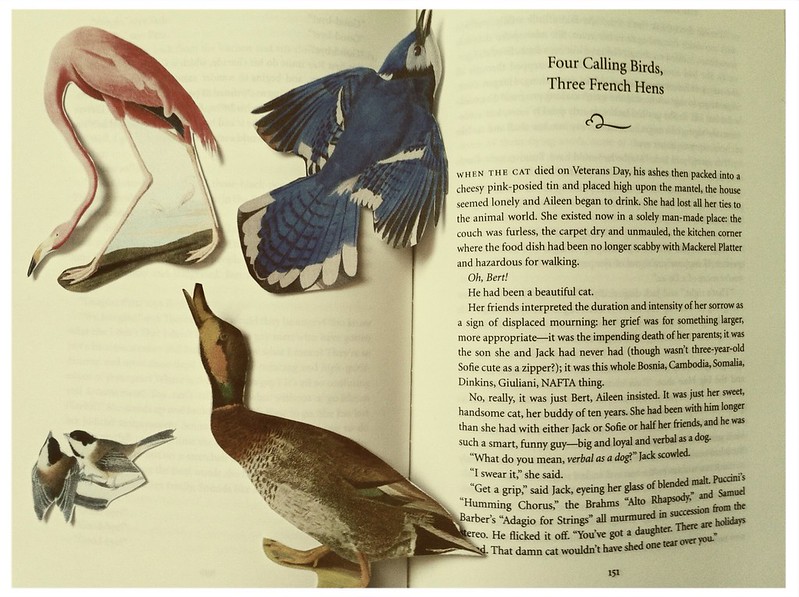
Although I know that the stories are not about birds, the title made me look for them. In the collection, I found: jays, ravens, chickadees, blackbirds and vultures, gulls, grebes, flamingos, geese, ducks and crows. Audubon (the author of the original Birds of America) is mentioned in What You Want to Do Fine. The main characters of this story, Mack and Quilty, have visited Audubon's house on one of their previous road-trip vacations. Although Audubon is mentioned in this story, I thought that the choice of Birds of America as the title of the collection had a greater meaning - perhaps Lorrie Moore's Birds of America is supposed to be a comprehensive reflection of the lives of various types of modern Americans. I am not sure about this analysis, and when I was reading the collection I did feel that maybe I was missing various points from not understanding enough about life in the US. In any case, I enjoyed this collection and found the writing clever and witty.


Sunday, 2 June 2013

Short Story Sunday - Roald Dahl

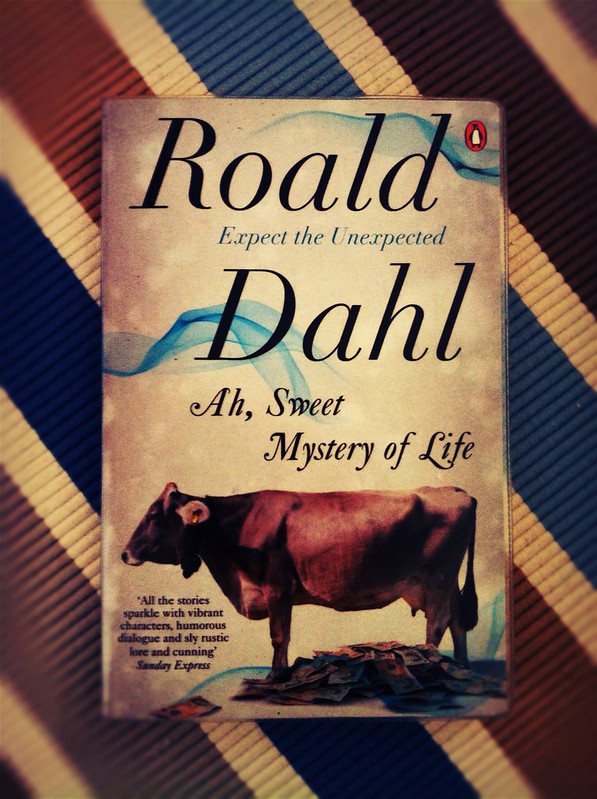
Ah, Sweet Mystery of Life: The Country Stories of Roald Dahl


After WWII Roald Dahl returned to England and spent some time living with his mother in Buckinghamshire. They lived in Old Amersham for a number of years and the country stories contained in this collection are set in the Chiltern Hills, in and around that town.

The collection, with illustrations by John Lawrence, contains seven stories (most of which were first published between 1953 and 1960). The longest story (Mr Feasey) is forty-three pages long, but, long or short, all the stories are easy to read, hilariously funny and quite often nauseatingly grotesque; I made the mistake of reading the revolting tale, The Ratcatcher, while eating breakfast.

The ratcatcher and his ferret.

Despite their apparent simplicity  and strong sense of time and place, many of the stories are timeless, masterful studies of human nature: the covetous antiques dealer in Parson's Pleasure who is ultimately vanquished by his own slick, well-practiced swindle; the fiance, who cannot hope to ever please his beloved's father, in Mr Hoddy; and the sly bookmakers at the greyhound track, in Mr Feasey, who prove that however much you think you might be pulling the wool over someone's eyes, you might just be being taken for a ride too. 


Sunday, 26 May 2013

Short Story Sunday - The Penguin Book of Victorian Women in Crime

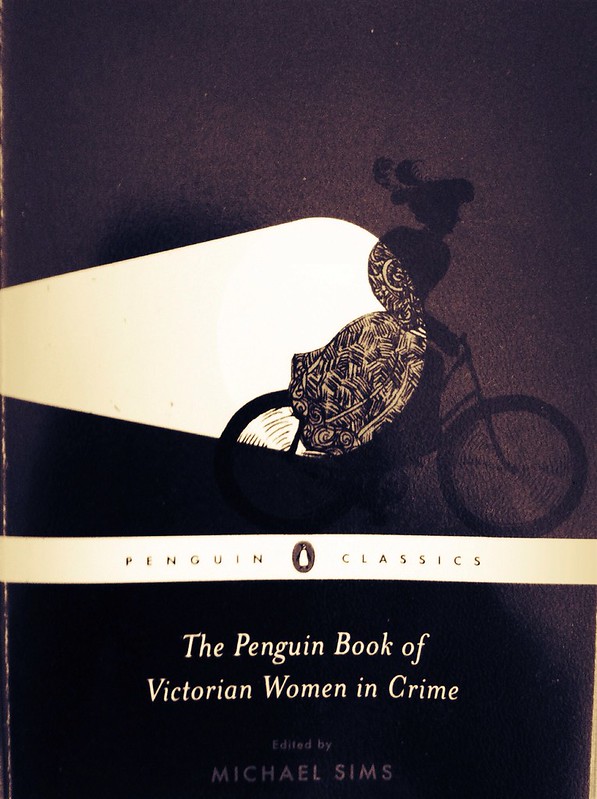
The Penguin Book of Victorian Women in Crime - Edited by Michael Sims


If you enjoy the stories of Arthur Conan Doyle's Sherlock Holmes, but would like to see some ladies involved in the crime-solving action, then this book is for you.

This Penguin Classics title, edited and with an introduction by Michael Sims, features ten short stories and one excerpt from a longer work:

  • The Mysterious Countess - W. S. Hayward (1864). This story shows Mrs Paschal - a professional detective who works for the police - in action solving the mystery of a wealthy countess' wealth and a bank robbery.
  • The Unknown Weapon - Andrew Forrester (1864). We meet Mrs G, another professional detective, who solves the mysterious death of Graham Petleigh, the son of the local squire of a Midland's town, who is found dead outside of the family home.
  • Drawn Daggers - C.L. Perkins (1893). Loveday Brooke is perhaps the first female detective created by a female author (four of the eleven stories in this collection are written by female authors). In this adventure she is hired to solve the case of a missing piece of valuable jewellery.
  • The Long Arm - Mary E. Wilkins (1895). The protagonist of this story, Sarah Fairbanks, is not a professional detective. After being accused, questioned and subsequently released for the murder of her father, Miss Fairbanks determines to investigate the crime herself as the police seem incapable of making further discoveries that would aid them in catching the murderer. Mary E. Wilkins was an American author and this story takes place in New England.
  • That Affair Next Door - Anna Katharine Green (1897). This is the one entry in the collection which is an excerpt from a novel rather than a short story. That Affair Next Door is available to read in its entirety on Project Gutenberg and the first chapter which appears in The Penguin Book of Victorian Women in Crime serves only to whet the appetite for Anna Katharine Green's entertaining female busybody detective, Amelia Butterworth. Anna Katharine Green is another American author; she grew up in Brooklyn and Buffalo and most of her stories are set in New York.
  • The Man With The Wild Eyes - George R. Sims (1897). Dorcas Dene is a former actress now married to an artist. She becomes a detective when she is compelled to seek work again after the illness and resulting blindness of her husband. Her neighbour, a retired policeman, gives her a start in the investigations business and when he retires she takes on his clients. Dorcas uses her skills learnt from the theatre to disguise herself on her various cases. In this story we see her impersonating a nurse in order to solve the riddle of a gentleman's daughter who has been attacked but pretends that a tramp carried out the assault. Dorcas is tasked with uncovering the real identity of the assailant.
  • The Adventure of the Cantankerous Old Lady - Grant Allen (1899). Lois Cayley has just graduated from Girton College and without any family ties she sets off to achieve her dream of travelling the world. As she doesn't have any money she funds the first stage of her journey by becoming a ladies' companion and accompanying a wealthy aristocrat on her trip to Germany. Lois keeps her companion's diamonds safe when a fellow traveller tries to steal them and helps the police to locate the would-be thief.
  • How He Cut His Stick - M. McDonnell Bodkin (1900). This story features professional detective, Dora Myrl. She is a plucky, new woman who is happy to get around on a bicycle and carries a revolver. In this story she is tasked with discovering how a large amount of gold was stolen by a thief who managed to disembark from a train travelling at more than 50 miles per hour.
  • The Man Who Cut Off My Hair - Richard Marsh (1912) - tells the story of Judith Lee who is a teacher of lip-reading, she relates an adventure from when she was twelve years old. She helps the police to catch a gang of thieves who have been carrying out thefts of valuable jewels and other belongings over a number of years. The twelve year old Judith succeeds where the professionals have failed due to her skills in lip-reading, so more a case of being in the right place at the right time rather than active detective work.
  • The Man with Nine Lives - Hugh C. Weir (1914). We are introduced to Madelyn Mack in this story. Hugh C. Weir's female sleuth is based on a real female detective, Mary Holland, who ran an investigations agency with her husband. Like Sherlock Holmes, Madelyn Mack is considered a genius by those around her, especially her sidekick Nora Noracker, and like Sherlock (famous for his cocaine habit), when she is bored she consumes cola berries as a stimulant
  • The Second Bullet - Anna Katharine Green (1915). This is the second story of the collection written by Anna Katharine Green. This story features her other female detective, the young, wealthy socialite Violet Strange.
Although the quality of the stories was rather up and down, the collection forms an excellent starting point from which to explore the adventures of fictional, female detectives. 


Thursday, 23 May 2013

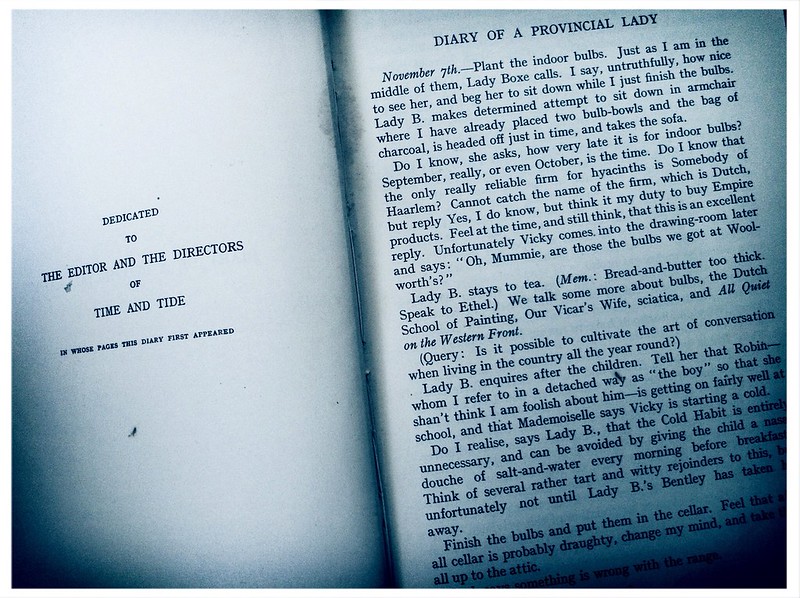
Diary of a Provincial Lady - E. M. Delafield


"Do I know, she asks, how very late it is for indoor bulbs? September, really, or even October,  is the time. Do I know that the only really reliable firm for hyacinths is Somebody of Haarlem? Cannot catch the name of the firm, which is Dutch, but reply Yes I do know, but think it is my duty to buy Empire products. Feel at the time, and still think, that this is an excellent reply. Unfortunately Vicky comes into the drawing-room later and says: "Oh, Mummie, are those the bulbs we got at Woolworth's?"
From reading this first scene of Lady Boxe's instructions regarding forced bulb planting, I knew I was going to enjoy Diary of a Provincial Lady. I found all the scenes which involved Provincial Lady's children, Robin and Vicky, very funny, particularly when visitors drop-in unannounced and seem to be slightly horrified by the behaviour of the children and their mother's inability to prevent it.

One particular scene which really made me laugh was when the superior Miss P. and her effete friend Jahsper visit the Provincial Lady one rainy afternoon. Miss P. takes off her wet cape (hitting her friend Jahsper in the eye with a weighted corner of the garment) and proceeds to lecture on Proust and the absurdity of names derived from flowers, like Rose, Daisy, etc. Just when Provincial Lady has had enough,
"Entire situation is, however, revolutionised by totally unexpected entrance of Robin - staggering beneath my fur coat and last summer's crinoline straw hat - Henry [Robin's friend from school], draped in blue kimono, several scarfs belonging to Mademoiselle, old pair of fur gloves, with scarlet school-cap inappropriately crowning all - and Vicky, wearing nothing whatever but small pair of green silk knickerbockers and large and unfamiliar black felt hat put on at rakish angle.
Completely stunned silence overtakes us all, until Vicky, advancing with perfect aplomb, graciously says, "How do you do?" and shakes hands with Jahsper and Miss P. in turn, and I succeed in surpassing already well-established record for utter futility, by remarking that They Have Been Dressing Up.
Atmosphere becomes very, very strained indeed, only Vicky embarking on sprightly reminiscences of recent picnic, which meet with no response. Final depths of unsuccess are plumbed, when it transpires that Vicky's black sombrero, picked up in the hall, is in reality the property of Jahsper. I apologise profusely, the children giggle, Miss P. raises her eyebrows to quite unnatural heights, and gets up and looks at the book-shelves in a remote and superior way, and Jahsper says, Oh, never mind, it really is of no consequence, at the same time receiving hat with profound solicitude, and dusting it with two fingers." 
 E. M. Delafield is witty and satirical about the lives and personalities of the adults in the Diary, but her treatment, although also very funny, of the children is sympathetic and touching.

In addition to having a good laugh, I also found the book quite educational when it came to popular literary trends of the late 1920s. I was inspired to find out more about the magazine Time and Tide which Provincial Lady reads and to which she submits work. If you are interested in the history of this magazine there is a short feature available on BBC Radio 4's Woman's Hour, which focuses on the magazine's founder,  the Welsh sufragette, and good friend of E. M. Delafield, Lady Rhondda. The segment is from an edition of the programme first broadcast in 2010.

The Diary was also quite useful for building a reading list of popular late twenties fiction. I found the following titles mentioned:

  • All Quiet on the Western Front - Erich Maria Remarque 1929
  • Harriet Hume - Rebecca West 1929
  • Orlando - Virginia Woolf 1928
  • The Good Companions - J. B. Priestly 1929
  • High Wind in Jamaica - Richard Hughes 1929
  • An American Tragedy - Theodore Dreiser 1925
  • Gentlemen Prefer Blondes - Anita Loos 1925
  • The Exciting Family - M. D. Hillyard 1927
  • The Edwardians - Vita Sackville-West 1930
I am not very well-read when it comes to 1920s and 1930s literature and have only read one of these titles. Which titles have you read and were they enjoyable?

At one of Lady Boxe's dinner parties, the Provincial Lady meets the author of Symphony in Three Sexes. I couldn't find this title when I searched. Does anyone know what it is? I thought it could allude to Freud's Three Contributions to the Theory of Sex 1905, or if it is meant to be fiction, maybe Lady Chatterley's Lover or The Well of Loneliness. Any help will be most appreciated.


Sunday, 19 May 2013

Short Story Sunday - Elizabeth Taylor

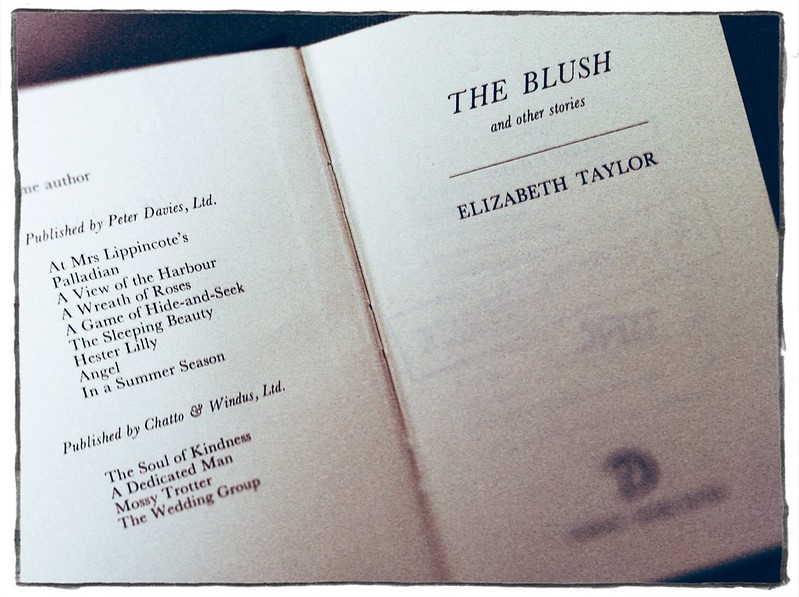
The Blush and Other Stories - Elizabeth Taylor


This collection of stories has been my first experience of Elizabeth Taylor (1912-1975). I know she is quite popular with book bloggers (I first heard about her through Jane at Fleur Fisher who is a big fan) so I had high expectations for this week's Short Story Sunday.

I haven't been overly enamoured by most of the short story collections I've read, which focus on the lives of women (Truman Capote, Julie Orringer, William Trevor, A.S. Byatt), but Elizabeth Taylor's stories have been my favourite so far. In common with the other collections, The Blush and Other Stories contains tales of women: trapped, suffering growing pains, grieving, disappointed with how life has turned out and other slightly depressing themes. However, the stories often feature a lightness and sense of hope which, combined with the author's sympathetic development of her characters, renders the tales less lugubrious than they might otherwise be. Perhaps the age of this collection (the stories were first published in 1951) makes them rather genteel and less gritty than modern writing.

The collection contains twelve tales:

  • The Ambush
  • The Blush
  • The Letter-Writers
  • A Troubled State of Mind
  • The True Primitive
  • The Rose, The Mauve, The White
  • Summer Schools
  • Perhaps a Family Failing
  • Good-Bye, Good-Bye
  • Poor Girl
  • Hare Park
  • You'll Enjoy it When You Get There

The Letter-Writers, which tells the tale of two friends - whose decade-long friendship has developed through correspondence only - meeting for the first time, was one of the most pathetic stories in the collection (as in arousing pathos, not contemptible or worthless). It seems that this story was inspired by the epistolary friendship Elizabeth Taylor shared with the novelist, critic and biographer, Robert Liddell. In addition to his friendship with Elizabeth Taylor, Robert Liddell also became friends with Barbara Pym whilst at Oxford. I have not heard of this writer before and I am rather intrigued by his choice of friends - I have read that both of these ladies are considered the best and most underrated female authors of the twentieth century. Please comment if you have read anything by Robert Liddell.

It's quite difficult to choose my favourite story from this collection, as I enjoyed so many of the stories. However, the final story, You'll Enjoy it When You Get There, keeps making me smile to myself days after I finished reading it. This story tells the tale of eighteen year old Rhoda who has to attend a business party with her father as her mother is in bed suffering from jaundice. Rhoda is painfully shy, which her mother finds a terrible failing,
"Self-consciousness it was always called when I was young, and that is what it is. To imagine that it shows a sense of modesty is absurd. Modesty. Why, I have never known a truly modest person to be the least bit shy."
Rhoda responds that it is alright for her, "You can drink. Then anyone can talk."

Rhoda's determined attempts at small-talk (about how her cat is from the same area as the location of the party) during the business dinner are amusing and result in the final hilarious scene on the dance floor.

This is not the only story with comic or light-hearted touches in the collection. I also found parts of: The Blush, The True Primitive and The Rose, The Mauve, The White amusing or outright funny.

I intend to try more of Elizabeth Taylor's writing in the future.


Sunday, 12 May 2013

Short Story Sunday - A.S. Byatt

Sugar and Other Stories - A.S. Byatt

I am beginning to wonder if maybe some of the short story collections I have been reading are better read over an extended period. Sugar and Other Stories left me with the same feeling as I had after reading the collections by William Trevor and Julie Orringer. Each story in these collections taken on its own is fascinating and wonderfully crafted, but read as a collection over the space of a week, or so, the themes (mainly dealing with women's lives: inter-generational conflict, parental death, betrayal, missed opportunities, etc) seem depressing and bleak.

My favourite stories from A.S, Byatt's collection are: Racine and the Tablecloth, Loss of Face and the title story. Sugar is an autobiographical story about the death of a female writer's father, the mythology that memory creates around the history of a family and a mother who lies. It is possible that Racine and the Tablecloth is also partly autobiographical as the story begins with a thirteen year old girl going off to boarding school; A.S. Byatt went to a Quaker boarding school at the age of thirteen. In any case, the study of the relationships between the pupils and the didactic methods of the teacher certainly had the ring of truth. If you have attended a girls' grammar, private or boarding school I am sure that this story will instantly transport you back to a time of (best) forgotten feelings and fears.

Loss of Face, along with The Dried Witch, forms the mid-section of the collection which moves the action to different cultures. The story follows Celia Quest, a female literary scholar, and her colleagues from a British university on their visit to South Korea where they lecture at a literary conference. Celia Quest is open to new experiences and wants to embrace this strange and alien culture. The title, Loss of Face, is a pun which describes Celia Quest's failure and the reason for her failure (she commits a grave faux pas because she does not recognise someone's face).

The only story which I didn't enjoy reading due to the structure rather than the subject matter was Precipice-Encurled. In this tale, Byatt combines real events that occurred at the end of Robert Browning's life with a fictionalised story about a young painter and a tragic event at a villa in the Apennines. I found it difficult to keep the different threads of the story straight in my mind and I really only "got" the fourth and main part of the story set in Villa Colomba.

As I bought a second-hand copy of this book, I was free to write on the text. My pencil was busy scribbling away as there were so many interesting literary features that jumped out at me as I was reading. Byatt uses a lot of inkhorn terms in her writing, but they are used judiciously, and not frivolously. I like learning something when I read and if I am reading fiction then I hope to be wowed and moved by language rather than facts. Two new words for me which I particularly enjoyed in this collection are "rebarbative" and "eructation".

I found Byatt's prose sonorous and rhythmic; she makes good use of alliteration, but it is subtle and sophisticated (not that I care about subtlety; I am quite content with the overuse of alliteration). For example, 
"She didn't see so far or focus so fast. She noticed her hips, on the Common, and had to make a real moral effort to see the hooded crow, or the hovering kestrel."
Repetition is also used quite frequently in many of the stories. e.g. "It is amusing. It is amusing that the same girls should already have been exposed to the betrayed and betraying cries of Ophelia's madness." Also, in The Next Room the word "precipitate" or "precipitately" (not really an everyday word) is used four times in a twenty-seven page story. The father of the main character, Joanna, is described as retiring precipitately. He did not live long after his retirement which suggests that sudden decisions and events have disagreeable outcomes, and Joanna says that she will not take any precipitate decisions about her parent's house or her future after her mother's death. Later she says that she will sell the house as soon as possible which leads one of her colleagues to remark, "Isn't that a bit precipitate?"

I really enjoyed A.S. Byatt's writing and although I found the collection rather sad (more action, less agonising.  That's my motto.) I intend to read more of her short stories, in particular The Matisse Stories which sounds very good.


Tuesday, 30 April 2013

Zoladdiction Round-up

The Masterpiece

Cafe Guerbois, the model for Cafe Baudequin in The Masterpiece from  Wikipedia

I enjoyed the first third, or so, of the story. I was surprised that Claude and Christine's relationship seemed to be progressing so smoothly - I had envisioned more of a dramatic, drama-filled toing and froing and the involvement of a third party. I thought that Irma Becot would have a part to play in their relationship, so I was not surprised when, at last, she did make an appearance in the story, although, by that time Claude had descended so far down the path of creative mania, that it no longer seemed to matter, as he really had no use for real women other than as models for his painting.

The section of the story from Claude's obsession with painting the nude woman in the Ile de la Cite scene until the acceptance of one of his paintings at the Salon was incredibly difficult to read: Claude is tortured by his inability to express himself fully through the creation of a masterpiece, both Christine and Claude are unbearably mean to their child, "The kid's an idiot, if you ask me", and the lovers' relationship is completely obliterated by artistic obsession, "She had ceased to exist, since all he could find to adore in her now was his art, and nature, and life."

Towards the end of the novel when we revisit the original "gang" and hear how their youthful ambition has, for the most part, been dashed on the rocks of reality, I began to feel less stressed by the overwhelming feeling of impending disaster. Life goes on, groups of friends grow up, move on and find new ways of living. Of course, this made the dramatic end of the story very shocking.

Among the artistic angst and desperation there were a few episodes which came across as light-hearted and made me smile.

I was amused when Sandoz, or rather, the putative Zola, tells Claude about his literary plans, and I think this quotation serves as a good description for the Rougon-Macquart series.

"I'm going to take a family and study each member of it, one by one, where they come from, what becomes of them, how they react to one another. Humanity in miniature, therefore, the way humanity evolves, the way it behaves... I shall place my characters in some definite period that will provide the milieu and the prevailing circumstances and make the thing a sort of slice of history, if you see what I'm getting at... I shall make it a series of novels, say fifteen or twenty, each complete in itself and with its own particular setting, but all connected, a cycle of books that will at least provide a roof in my old age, if they don't prove too much for me in the meantime!"
I also found the character of Mathilde amusing, particularly at the end when she has Jory well and truly under her thumb.

Lastly, my favourite quotation, by far, is from a scene, early in the novel, at one of Sandoz's Thursday dinners when the talk turns to models, "Mahoudeau was furious because good bellies were a thing of the past; it was impossible, he said, to find a girl with a belly worth looking at." Down with washboard stomachs!

I can't say that I enjoyed this novel, but it is certainly a fascinating read if you are interested in: the creative process, French Impressionism or the groupe des Batignolles.


Final Summary

I had hoped to read more novels than I did. When I signed up to Zoladdiction, I chose to read only two novels as I knew I would be moving house and that any more would probably be too ambitious. Eagle-eyed readers will have noticed that the location in my profile has now changed, as in the last month I have moved 400 miles southwards. It has been a challenge keeping up with my reading and posting my impressions of Zola's work, but I have really enjoyed this reading event and hope to take part in more events in the future.

Works Read

  • Germinal
  • The Masterpiece
  • Captain Burle (a short story)

Favourite Work Read

Without a doubt, Germinal. I can definitely see myself reading this novel again and again.

Favourite Characters

La Maheude in Germinal for her strength and resistance and Sandoz in The Masterpiece for his constancy and loyalty to friends and family. I didn't like the main, male character in either book; Etienne seemed foolish and naive but well-intentioned, and I don't have a positive word to say about the character of Claude.

Future Zola Reading Plans

I would like to read some more novels from the Rougon-Macquart series, particularly: La Bete Humaine and Pot Bouille. I also plan to read a novel outside of the series and think this will probably be Paris from Zola's Three Cities Trilogy.


Thanks Fanda and O for hosting this event.

Sunday, 28 April 2013

Short Story Sunday - Emile Zola

Captain Burle - Emile Zola


Having read a collection of stories by Guy de Maupassant for last week's Short Story Sunday, I have to say that I don't think I would be able to tell the difference between a Zola story and a de Maupassant one, as regards plot. Of course, as I am reading translated works, I can't comment on the differences, if any, in use of language between the two authors. Like many of the stories I read last week, Captain Burle is a farcical tale which seems humorous at times but ultimately has a tragic ending.

Captain Burle, his aged mother and young son live together in straightened circumstances in a provincial garrison town. Captain Burle, who has given up active duty and now grows flabby in a desk job as quartermaster, is a disappointment to his martinet of a mother who harbours thoughts of martial glory and honour for her son. She is determined to raise her grandson in a strict manner filling his head with ideas of soldierly daring and courage so that he is ready for military school as soon as possible. Captain Burle's son is a delicate, soft child who despairs at the thought of military life and war.

One stormy evening Major Laguitte (who has a marvellous catchphrase of "thunder and lightning!" which brings to mind Captain Haddock and his "thundering typhoons!") hammers on the door of Captain Burle's apartment in a furious rage. Captain Burle is not at home (he spends his evenings carousing with Melanie at the Cafe de Paris) so Major Laguitte tells the Captain's mother that he has discovered that his subordinate has been embezzling garrison funds. The Major served under Captain Burle's father and as a friend of the family is keen to avoid scandal by covering up the fraud and remonstrating with the Captain forcing him to mend his ways. 

Where did the embezzled money go? Certainly not on Captain Burle's family. No, Captain Burle, who is considered an incorrigible philanderer (he is nicknamed Petticoat Burle by his men), spends his evenings flirting with Melanie, the owner of the local "bar", and spends his money on buying her affection. Major Laguitte marches over to the Cafe de Paris, hauls Captain Burle out of the bar and gives him a good talking to. It seems that the Major's intervention has reformed the Captain, as for the next few weeks he stays quietly at home and can be found snoring in bed at nine o'clock. 

Major Laguitte begins to relax and thinks that the problem has been solved, until, one day, when casting his eye over the accounts he notices irregularities in Captain Burle's accounting once again. He can't understand where Captain Burle has been spending the money as apart from his duties he never leaves his home. He also realises that even if he urges Captain Burle to mend his ways countless times, the Captain will always return to his habit of cheating.

The Major resorts to a drastic course of action, in order to put an end to Captain Burle and the constant threat that he will sully the memory of his late father and dishonour his mother and son. Even though he only has the use of one leg, he decides to challenge Captain Burle to a duel - if he kills the Captain the problem will be solved and if he himself dies then he will not have to witness the shame that the Captain's actions bring on his family. As the Major is the Captain's superior he cannot get permission to duel without first resigning his commission. The papers take a long time to come through, but at last the much anticipated day of the duel  arrives. 
"The majority believed that Laguitte would be run through the body in three seconds, for it was madness for a man to fight with a paralyzed leg which did not even allow him to stand upright. A few, however, shook their heads. Laguitte had never been a marvel of intellect, that was true; for the last twenty years, indeed, he had been held up as an example of stupidity, but there had been a time when he was known as the best fencer of the regiment, and although he had begun as a drummer he had won his epaulets as the commander of a battalion by the sanguine bravery of a man who is quite unconscious of danger."
The duel is fought and the Major is victorious. Shortly afterwards, Captain Burle's frail son, who desperately hoped not to attend the military academy, dies.


Saturday, 27 April 2013

Books, Baguettes and Bedbugs

I was rather excited when I stumbled across this book whilst searching for titles to read for my French-themed, April. Paris and a secondhand bookshop, "That's going to be good!" I said to myself. Although I had heard about Shakespeare and Company, I have never visited the bookshop and, in fact, I have only been to Paris once, year ago on a school trip.

George Whitman, an American expat, started his English language bookshop in Paris in 1951. The original shop was called Le Mistral, but in 1964 George changed the name to Shakespeare and Company in honour of the famous store run by another American expat, Sylvia Beach, which had closed in 1941. In addition to selling books, George's bookshop had beds tucked between the bookshelves where writers and other literary folk could stay for free as long as they helped out in the shop and tried to adhere to George's rule of reading a book a day. He also provided food for his guests and visitors and a library which the residents could use.

Jeremy Mercer's memoir of his time at the bookshop (he arrived in January 2000), is part travel writing and part history of the shop and biography of its owner. After reading the first couple of chapters I didn't think I was going to like this book, but I decided to give it a chance and at least read a hundred pages. At first, I found it too sensationalist - the author (a former crime reporter) runs away to Paris after receiving a death threat from a shady acquaintance in his native Canada - the dialogue is stilted and cliched in places, particularly when he tries to give a voice to the English men he meets at Shakespeare and Company, for example, "Don't worry, old boy" and "Oh, hello, old boy. I don't know where my head is these days.", and I didn't particularly warm to some of the stories of the self-indulgent, student type characters resident at the bookshop. However, the book improves markedly at about the halfway mark and by the time I finished I decided that I actually liked this book a lot. By the end the author came across as sincere and unpretentious and the story of the bookshop and George Whitman's experiment of how to live a different, more equitable and humane, kind of life was really quite inspiring.
"There are few men I admire more than George. Though far from perfect and rife with idiosyncrasies  George, with all the hope and optimism of a child, still believes he can change the world and change the people he takes in at his store. In an age when it is so tempting to be cynical, this is enough to make him a hero in my eyes."
George Whitman died in December 2011 (you can read an obituary here); his bookshop continues under the ownership of his daughter who is called Sylvia Beach Whitman.