I haven't provided a general profile of Plymouth Central Library yet, but, yesterday, I was very fortunate to be able to attend a "behind the scenes" tour at the library. As the day of the tour approached I became increasingly excited, and I wasn't disappointed! The tour was fascinating, and I hope I can attend more of these events at other libraries in the future as they are incredibly thrilling for a library lover.
Plymouth got its first public library in 1876 which, until 1910, was housed in the Old Guildhall. The foundation stone for the new library (the current building) was laid in 1907 and officially opened in 1910.
 |
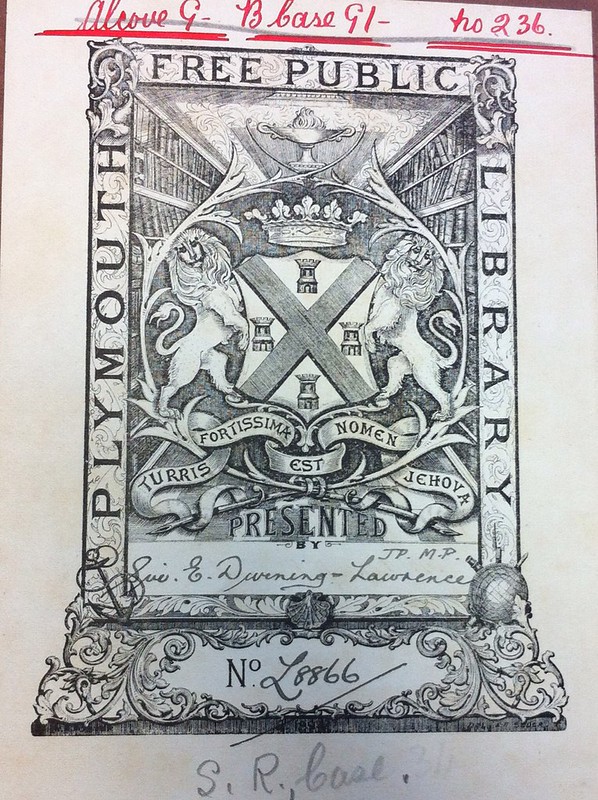
Original bookplate from the Free Library.
It features the coat of arms of the Corporation of Plymouth. |
William Wright, the first librarian of Plymouth's public library, wrote to the Carnegie Trust on a number occasions requesting financial help for the establishment of a dedicated library building for Plymouth. In 1906 Andrew Carnegie offered £15,000 pounds which, despite a measure of anti-capitalist discussion among the members of the Town Council, was subsequently accepted. This gift did not quite cover the costs of construction as per the architect's original plans which feature first floor windows in the facade of the building. The building was constructed without these windows which means that the first floor reference section gets rather hot on sunny days as it does not feature dual aspect windows. Almost from its inception the new, purpose built library was too small for the population of the city. When the library was planned, built and opened the population of Plymouth was 100,000, but in 1914, this figure doubled overnight when the towns of Devonport and Stonehouse merged with the city.
The tour started on the first floor and after a short talk on the history of the library we filed downstairs to the ground floor which took us past the impressive stained glass window. I will provide more pictures of this window when I return to the library for a profile of the public parts of the building.
Plymouth Central Library suffered badly in WWII. This stained glass window is the only window to survive the war thanks to the prescient actions of some public servant, who had the window removed and taken to
Buckland Abbey for safety. In April 1941 the Library was hit by incendiary bombs causing the destruction of the library stock, some 85,000 volumes. All that remained after this raid was the facade and some internal walls.
The library service picked themselves up after this devastating blow and opened a temporary library service next door in the Museum. They started with several thousand volumes (all the books that had been out on loan at the time of the fire), but this number quickly increased thanks to generous donations. Reconstruction work started on the damaged Library in 1954 and by 1956 the Library was open for business again.
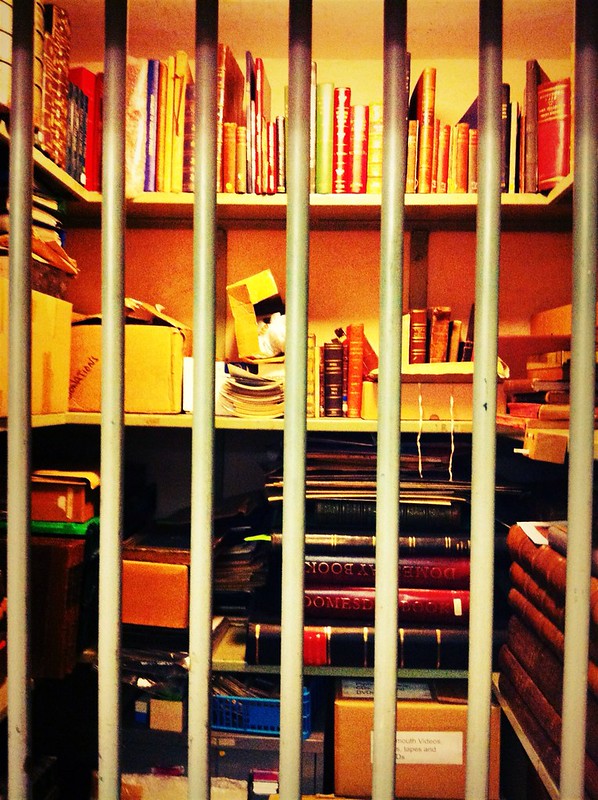
Our first look at the non-public areas of the Library took us down some narrow stairs, past a large store of toilet rolls, to the basement which houses moving stacks full of local and naval history volumes. We also got the chance to have a look at the vault, where valuable items are held including some of the more financially valuable volumes of the Moxon Collection.
 |
| "Let me out of here! I want to be read." |
Charles Chapel
After looking around the basement we ascended the stairs and exited the Library from the back in order to cross the road to the Library Annexe. The Annexe houses library offices, the orchestral collection and the bulk of the fiction and non-fiction lending stock.
 |
| Library Annexe on the left and the back of the main Library building on the right. |
The day of the tour was lovely and sunny, but I can't imagine it is much fun for the library assistants to have to cross the road in the rain in order to look for books for library patrons.
As you can see from the picture, the Library Annexe is a disused church. Charles Chapel, later called St Luke's Church was opened for worship in 1829 and eventually closed for regular services in 1962. After that time, it was used occasionally for weddings and baptisms, but eventually it was deconsecrated and sold to the Town Council. The building became the library bindery in 1970 and after that took on its current role.
We entered the Annexe by a door at the far left of the building which brought us into the packing and storage area of the Library's large collection of orchestral sets. Plymouth holds the largest collection of orchestral sets in the South West and these can be borrowed by other libraries across the country, hence the packing area.
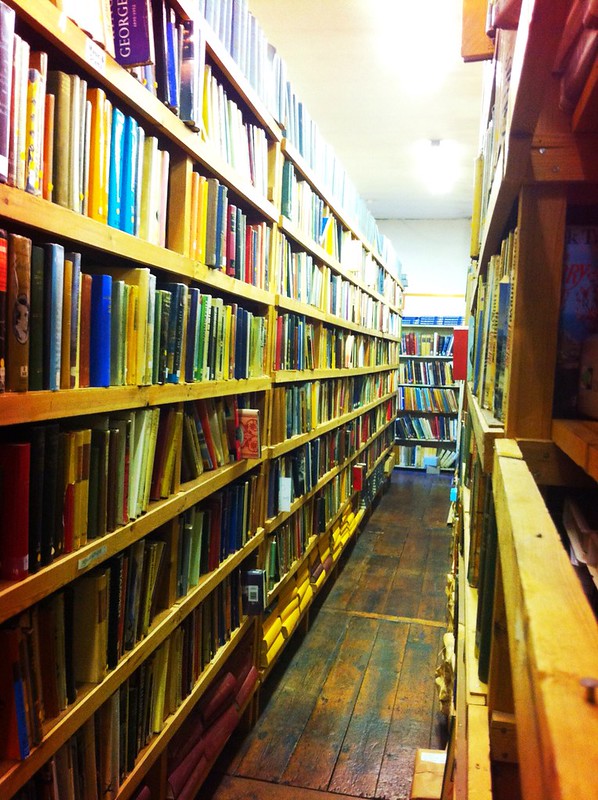
We walked through this area and then entered the main room of the building which is filled with stacks of fiction and non-fiction (now I know where some of the books I borrow are stored).
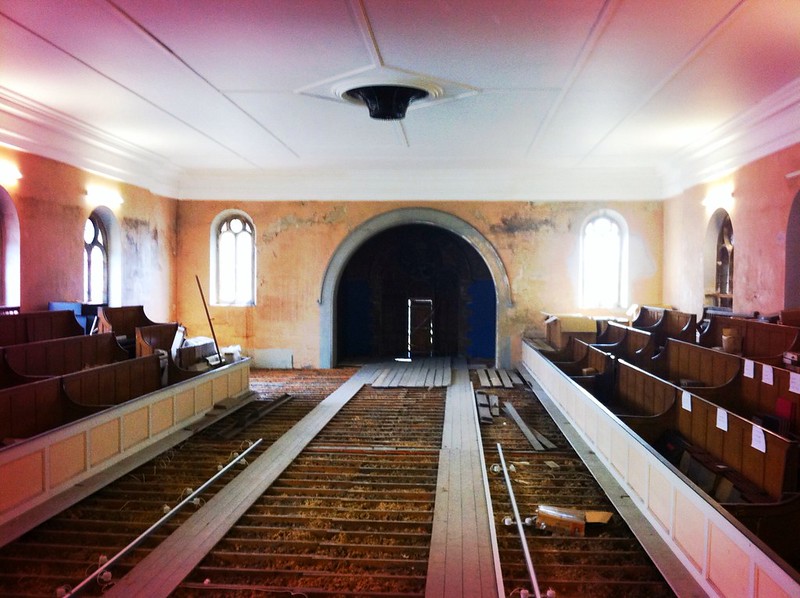
Despite the age of the building and lack of modern climate control systems, our tour guide said that there are no problems with damp and that temperature control doesn't prove that much of an issue. This section of the building does not give you the feeling of being in a church; however, the lucky "behind-the-sceners" were given the chance to explore the gallery, which apart from the false ceiling that separates the working section of the building, is pretty much untouched.
It was very dusty in the gallery, but all the furniture was in quite a good state of repair. The lead in the stained glass windows on the right hand side of the picture is weak, so they have been bricked up to help preserve them.
The iron ceiling rosettes would have contained gas lamps. The ceiling looks clean and shiny in the pictures as it was restored twenty years ago.
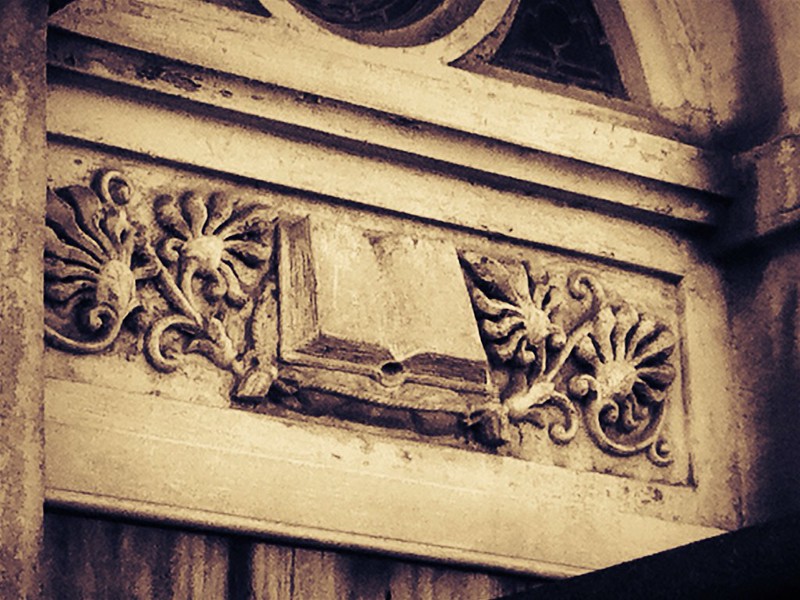
When we left the Annexe I noticed a wonderful carving on the outside of the building. The carving is of a book; I am sure it was originally carved to represent the Bible, but I liked the fact that it continues to reflect the purpose of the building.today.
 |
| There are books in here. |
The Moxon Collection
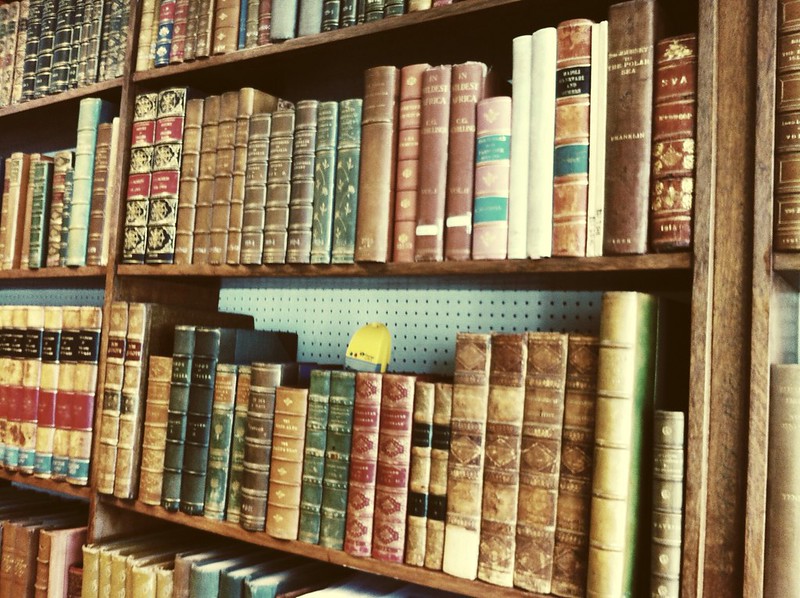
We crossed back to the main library building and gathered in a meeting room on the first floor. This room holds the bulk of the Moxon Collection.
Alfred Moxon was a naturalist and travel writer who bequeathed his book collection to the Library in 1932. This precious collection survived the war as it was also stored for safe keeping at Buckland Abbey. The books include the collection of his sister, Louise, who predeceased her brother and from whom he inherited. Alfred Moxon does not seem to have had any connection to Plymouth; I am sure the librarians were extremely grateful, but, perhaps a little bemused on being contacted by his solicitor. Recent research has shown that the Moxon family may well have been related to the Drake family which could explain his gift. The books are beautifully bound and many of the natural history tomes are quite valuable.
This was the final part of an intriguing and fascinating tour.