Showing posts with label Non-Fiction. Show all posts

Tuesday, 31 December 2013

2013: Reading Round-up


I have written blog posts about 32 books this year (14 non-fiction and 18 fiction which includes short story collections). In total I have read forty-five books and failed to finish another ten, which is probably about average for me. The books I have blogged about were all written by British, American or French authors, so one of my goals for blogging in 2014 is to write about books written by authors from other parts of the world.

Favourite Fiction 

Maybe you can tell from the enthusiastic postings that Emile Zola's Germinal was my favourite novel of the year. I read two Zola books as part of the Zoladdiction event hosted by Fanda and enjoyed both of them. 

Favourite Non-fiction

My best non-fiction read of the year was Anne Fadiman's At Large and at Small: Confessions of a literary hedonist which I read back in March. I didn't blog about this collection of essays here, but I am planning to reread this again in 2014 so will write about it then. I actually ended up reading this as Ex Libris: Confessions of a common reader was missing (maybe it's so good someone stole it?) from the library when I tried to borrow it, I plan to read this in 2014 too.

Off-blog Reading

I have read quite a lot of Scandi noir this year. I am probably rather late in discovering this crime fiction trend, but being behind the times hasn't dampened my enthusiasm for snowy landscapes and depressed, middle-aged detectives. 

At the beginning of 2013 I watched both series of the Swedish production of Wallander with Krister Henriksson, so I began by reading a few of Henning Mankell's novels. The other  Swedish authors I read were Maj Sjowall and Per Wahloo and Stieg Larsson. 

A few months ago I discovered the Icelanders: Arnaldur Indridason and Yrsa Sirgurdardottir (both of these surnames are written with an eth: the fifth letter of the Icelandic alphabet, but I don't know how to insert it with Blogger - sorry Icelanders, Faroese and Anglo-Saxons). I don't think I have ever read Icelandic literature translated in English before, and in fact, apart from hot springs, volcanic eruptions and banking crises, I know very little about Iceland. In these novels, history doesn't stay in the past and in the four books I have read so far,  secrets and  hidden crimes resurface after many years causing death and destruction for the modern day players of the stories.


2013 has also seen me experiencing cyberpunk for the first time. I planned to read Neal Stephenson's Snow Crash and William Gibson's Neuromancer choosing these as archetypal works of the genre. After looking on my local library's shelves, I ended up with Stephenson's The Diamond Age and Gibson's Pattern Recognition.

Pattern Recognition was not what I was expecting at all. I thought it would be set in the (near-ish) future and would feature lots of discussions around computer science and artificial intelligence. It didn't. The book is set in 2002 and in a pre-Twitter and pre-YouTube world feels rather dated. The central character, Cayce Pollard, is a cool-hunter who consults for multi-nationals and advertising firms about the latest trends. The book is a fast-paced thriller set in London, Russia and Japan and it was a real page-turner which I finished in about two days. However, certain elements of the plot and characterisation, in particular, annoyed me - Cayce suffers from an anxiety disorder brought on by certain logos: nausea brought on by Prada and Louis Vuitton. I wouldn't have thought that such a "disorder" would be much of a problem. Now, if it was Primark that would be another story. 

I will consider reading another William Gibson novel as I found Pattern Recognition a bit cheap-thrillerish, so I think his other works will probably be quite fun and not take too long to read.

The Diamond Age was probably the most difficult book I read this year. It had a highly complex plot with a lot of moving around in the timing of events (making it a bit difficult to keep track of where I was) and in depth discussions of Turing machines, nanotechnology, societal groupings and collective consciousness. Although I struggled with this novel, I still plan to read Snow Crash, as Neal Stephenson's writing deals with some really interesting discussions about the use of technology in society.

Monday, 30 September 2013

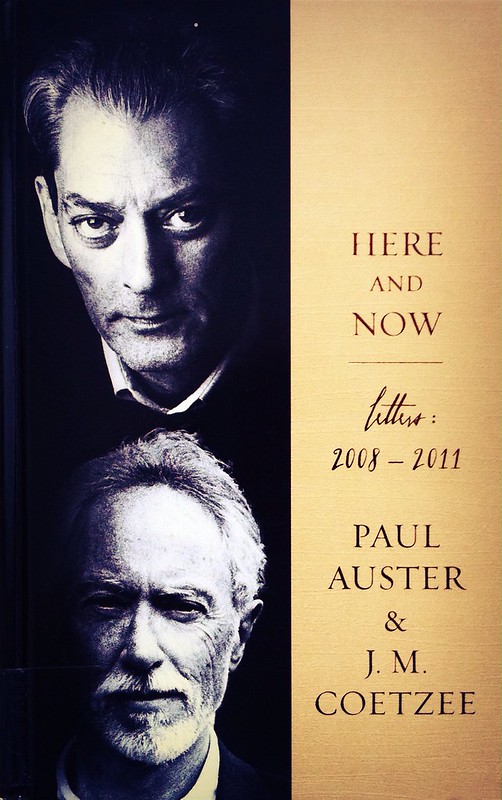
A Life in Letters - Here and Now, Paul Auster & J.M. Coetzee

Here and Now, Letters 2008 - 2011 by Paul Auster & J.M. Coetzee


I spend a lot of time researching what to read next. In fact, I think I spend more time discovering new books on various themes than actually reading. Despite this controlled and pre-planned approach to my reading I do occasionally read books (often rather good ones) which I come across in a more serendipitous manner. 

Here and Now belongs to this category of serendipitous finds. This book attracted my attention while I was browsing the 800s section (literature) in my local library. Faber and Faber did a great job of producing this collection of letters: it is a lightweight hardback book, with tasteful portraits of each author on the cover and it has wonderful chocolate brown end-papers (my favourite colour). As this is a collection of letters many pages feature quite a lot of formatting at the top of the page: date, address, Dear John or Dear Paul.  I liked the fact that the pages had been arranged with balance in mind by placing the authors' names (verso page) and the title of the book (recto page) at the foot of the page. 

The physical appearance of the book encouraged my to pick it up, but beyond aesthetics, I didn't know anything about it or have any preconceived ideas about what I would find inside, when I checked the book out. I have not read any of Paul Auster's writing and although I have read Disgrace I used to think that J.M. Coetzee was a woman, not a man (I also used to think that A.S. Byatt was a man and not a woman)!

I found the collection very readable indeed, and I think the diverse topics discussed in Auster's and Coetzee's letters would appeal to many people. Among other topics, they exchange ideas about sports (the concept of losing in individual games versus team games. Take singles tennis, for example, the majority of entrants in a tournament will be losers and not winners), the financial downturn and capitalism, film, how to deal with literary criticism and critics, the challenge of the digital age in novel writing,
"You say that you are quite prepared to write novels in which people go around with personal electronic devices. I must say I am not. The telephone is about as far as I will go in a book, and then reluctantly. Why? Not only because I'm not fond of what the world has turned into, but because if people ("characters") are continually going to be speaking to one another at a distance, then a whole gamut of interpersonal signs and signals, verbal and nonverbal, voluntary and involuntary, has to be given up. Dialogue in the full sense of the term, just isn't possible over the phone." [From J.M. Coetzee to Paul Auster April 2011).
And, discussions on the degradation of culture since the late 1970s, early 1980s (although, don't most people over the age of about 55 make a similar lament?).

In addition to containing interesting discussion on a varied list of topics, I also found the letters quite touching. The authors express delight at the opportunity of meeting each other in person at literary festivals (to be in the same place, at the same time is quite a feat as Paul Auster lives in New York City and J.M. Coetzee lives in Australia) and on return home from their meetings they say how much they enjoyed being able to spend some time together. The warmth that shines through their letters makes me want to pick up my pen and write an old-fashioned letter to a friend.


Saturday, 7 September 2013

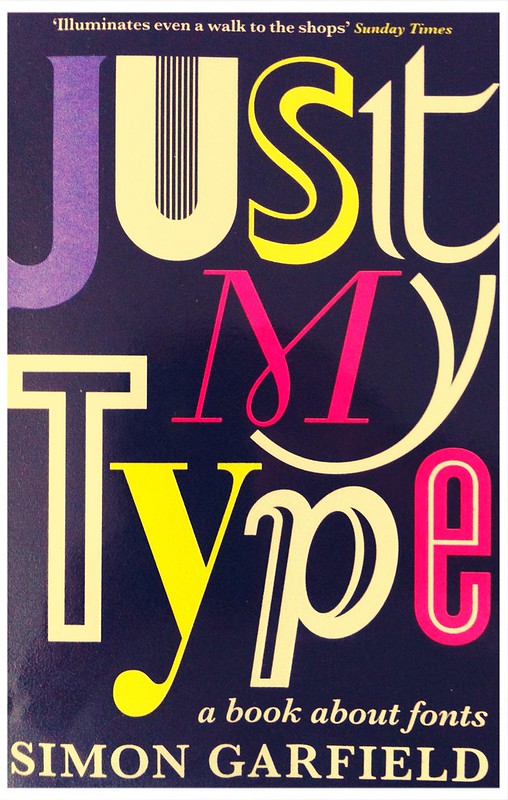
Just My Type: A Book About Fonts by Simon Garfield


There is a serendipitous satisfaction in enjoying a book which found you rather than you searching it out. A while ago I was at the library browsing in the section where I expected to find the 745.6 classmark (calligraphy). Even though my local library holds just four or five books on calligraphy I was surprised that I couldn't find any of the books on the shelf even though the catalogue said they were in the library*. Just My Type jumped out at me with it's striking cover and subtitle, "A Book About Fonts" and although it wasn't what I was looking for I thought I would give it a try.

Before reading this book I can't say that I thought about fonts much apart from choosing which fonts to use for my blog (the main script is Arial - not much thought there then, as this is the font I use for nearly all my computer produced texts - and the blog title and post titles are in Dancing Script which Google Fonts advise using "when you want a friendly, informal and spontaneous look". I wasn't aiming for spontaneity, just a contrast and, yes, I am a sucker for cheesy brush script pretending it's hand written and not really type.

Simon Garfield's survey of fonts deals with: the history of popular typefaces: Garamond, Gill Sans, Times New Roman, Baskerville, biographies of famous type designers: Lucas De Groot, Adrian Frutiger, Eric Gill, Matthew Carter, Margaret Calvert (the designer of Calvert, the font used on the Tyne and Wear Metro), the history and job of type foundries and how the innovations of the digital age have changed the nature of type designing and our relationship with type, "Computers have rendered us all gods of type, a privilege we could never have anticipated in the age of the typewriter."

This book made me look around a lot more at signs (road signs, street signs, shop signs) and think about the form of what I was looking at and not just the content.  I have also been paying more attention to the form of the books and magazines that I read. I picked up ten books from my shelves at home and was disappointed to find that only three out of these ten books credited the font on the copyright page. The fonts used were: Giovanni Book (designed by Robert Slimbach in 1989), Granjon an old-style serif typeface from 1928-29 and a similar typeface, Ehrhardt from 1938. I also had a look at my Oxford English Dictionary which uses Swift (a sans-serif from 1985) and Arial (1982) presumably for legibility.

I haven't read any of Simon Garfield's work before, but based on my experience with this book - an entertaining, witty and fascinating introduction to a subject about which I knew very little - I hope to read more of his work. He is a rather prolific non-fiction author, so there are lots of other titles from which I can choose.

Oh interrobang, how had I never seen or heard of you before? Okay, it's not a font, just a single character, but the interrobang is one of the fun little factoids that I will be taking away from Just My Type.  If you too want to represent quizzical surprise then input Alt + 8253 in Microsoft Word.


* The calligraphy books had been moved to a separate Arts and Crafts section in the area of the library which houses the "popular" books: Home and Gardens, Family, Health, Cooking. I hate it when the library is arranged like this; please, when using Dewey just start at the beginning and progress in a systematic order, it makes it so much easier to find items.

Sunday, 18 August 2013

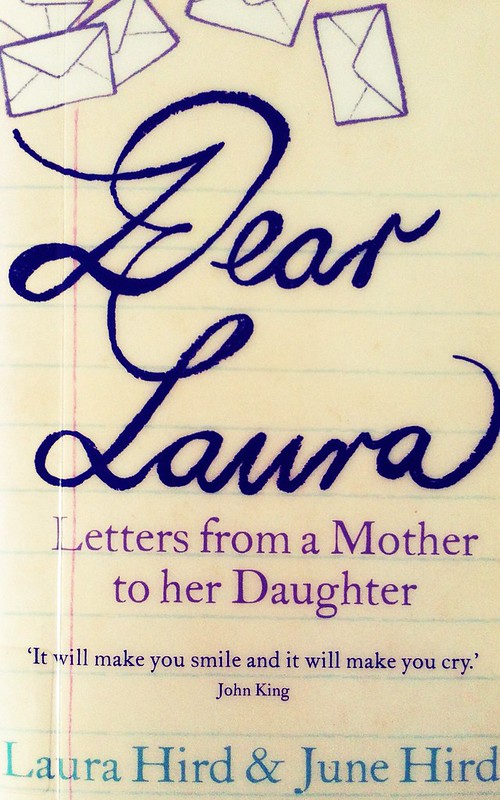
A Life in Letters - Dear Laura: Letters from a Mother to her Daughter

Dear Laura: Letters from a Mother to her Daughter - Laura Hird & June Hird


Elizabeth Chatwin, the widow of Bruce Chatwin said, "letters are the most vivid writing" and in reference to the book I read this week, I would certainly agree. The letters which fill Dear Laura are full of wit, sentimentality, sometimes admonishing, full of gossip and quotidian banalities, but always vivid and entertaining.

The majority of letters in Dear Laura cover the years 1988 - 1991, when, at the age of twenty-one, Laura Hird left her working-class home in Edinburgh to attend university in London. All bar one of the letters are from June to her daughter.

Laura is an only child, and despite a sometimes fraught relationship, the bond between daughter and mother is an incredibly close one. After signing off one of her letters, June writes "till midnight" as before leaving home Laura and her mother had agreed that every night at midnight, even though they will be 400 miles apart, they will think of each other and send good "vibrations" to each other. They also send a plastic, lucky horseshoe back and forth depending on who needs the most luck at any particular time, which reveals as much about Scottish culture as it does about the love and support mother and daughter show each other.

I can't say that I found the twenty-one year old Laura a particularly sympathetic character. In the letters she comes across as incredibly spoiled and struggling to survive her entry into independent adulthood after a sheltered childhood. Her mother often sends stamped addressed envelopes to London along with her own letters, which contain thank you notes for various friends and relatives who have sent Laura money or birthday cards and presents and all Laura has to do is pop them in a postbox in London, so they have the required postmark. In one letter June describes visiting Nannie an elderly relative who, "was in tears today about the beautiful letter you didn't write for her birthday fiver. It had pride of place on her sideboard and she made me sit and read the letter I had written, while she wept at how sweet you were."

June Hird is an accomplished letter writer (with the added ability of forging thank-you notes!) having had plenty of practice. At the end of one of her letters she says, "I must stop. I have 6 more letters to write." When was the last time you wrote one letter, let alone seven in one day? Her letters are often funny whether relating anecdotes of her daily life in Edinburgh or just expressing her thoughts. I was particularly amused by a discussion on the merits of coloured writing paper.
"Why is it healthy to write on technicoloured notepaper? - well according to a TV programme last week bleached paper contains the deadly poison dioxin. Tea bags, coffee filter paper, white tissues and toilet paper, disposable nappies and tampons, and notepapers are all suspect. Only recycled paper is safe.
Who wants to write a letter on a recycled tampon, toilet roll or nappy? Even if one does tend to write a lot of verbal diarrhoea, one doesn't need to have one's nose rubbed in it as a punishment. Thought-provoking, isn't it?"
If you are looking for a memoir about the relationships between mothers and daughters, read this book. However, don't be tricked into expecting a heartwarming tale of sentimentality, this is also a great read for anyone interested in late 1980s, early 1990s Britain: polytechnics, poll-tax riots, Margaret Thatcher and classic TV (I'd forgotten all about Lilo Lil from Bread). Dear Laura is a fascinating, easy-to-read piece of social history and a beautiful tribute to Laura Hird's parents.


Sunday, 28 July 2013

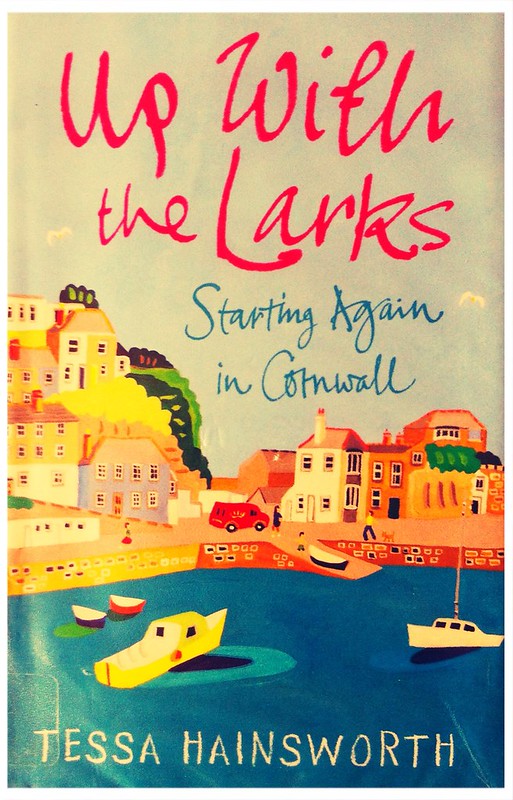
A Life in Letters - Up With the Larks: Starting Again in Cornwall

Up With the Larks: Starting Again in Cornwall - Tessa Hainsworth


I mentioned in my introductory post to A Life in Letters, that I would be reading a wide range of books related to letters and letter writing. This week instead of reading a collection of letters I read a memoir about a letter collector, i.e. the postman, in this case, a postwoman.

Up With the Larks tells the story of Tessa Hainsworth and her family as they adjust to life in a small seaside village. Tessa Hainsworth leaves her high-powered job in London and in an escape from the rat race, moves, with her husband and two young children, to South Cornwall. 

The book charts their struggles to keep financially afloat after their initial business plan designed to provide their livelihood in Cornwall collapses,
"Our golden dream was slowly turning to dust as we worried ourselves sick night after night. By this time we didn't even know if we could afford to move back to London, where we could at least find work."
Forced to find jobs, Tessa and her husband apply for everything from receptionist to taxi driver and supermarket assistant manager. Her husband ends up working multiple part-time jobs and Tessa, much to the surprise of her friends and family, gets a job with Royal Mail delivering the post.

Tessa is initiated into the life of a postwoman during the busy pre-Christmas delivery weeks by barking dogs, savage cats and suspicious locals. Ms Hainsworth's storytelling is both witty and engaging and the parts of the memoir that deal with her daily round and the lives of her customers (particularly the sympathetic descriptions of elderly Mr Hawker and the B&B owners Martin and Emma) make this book an enjoyable read.

There were elements of the writing that made me squirm in my seat and think that the book could have done with more strident editing. On its third appearance, I was thoroughly fed up with the figurative use of clotted cream, e.g. "one minute as thick as clotted cream and the next sparring with each other". Also, when her husband returns from providing a massage at the local, upmarket hotel she says, "I hope it was a rich Eastern European princess who was so thrilled by your exquisite application of healing oils and massage that she gave you a huge tip". Shouldn't that be Middle Eastern princess? I think you would be hard-pressed to find an Eastern European princess anywhere, let alone in Cornwall.  

Despite these pedantic niggles, I did enjoy this quick and easy read. Tessa Hainsworth's memoir must have enjoyed a measure of commercial success, as since the publication of Up With The Larks  in 2009 a further two books (Seagulls in The Attic and Home to Roost) about village life on the Roseland peninsula have been published.


Sunday, 21 July 2013

A Life in Letters - The Letters of Vincent Van Gogh, Part Two

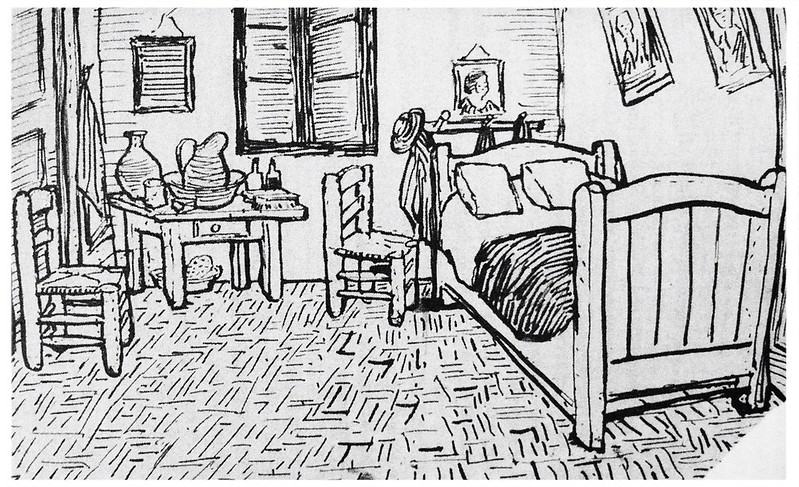
Enclosed sketch from a letter dated 16th October 1888.

I finished The Letters of Vincent Van Gogh this week and, I think I may have found a contender for my book of the year. 

Vincent Van Gogh's letters have been fascinating to read and have really changed any preconceived ideas I may have had about the great artist. I didn't really know that much about Van Gogh before I picked up this book - I love some of his paintings, but I had the general idea that he was a madman who cut off his ear and eventually committed suicide.

Reading these letters showed me a man who was dedicated to the creation of art and who longed for close relationships and a family, but who faced obstacles (poor health and poverty) in the pursuit of both of these goals. 

The letters in the second half of the book detail Vincent's disputes with his mother and father and the strain that this puts on his relationship with his brother Theo (to whom most of the letters are addressed). The close relationship which the Van Gogh brothers clearly had is one of the elements of the letters that attracted me when I started to read the book. That their relationship is sometimes strained is understandable when you take into account that Theo more or less supported Vincent throughout his adult life by sending him money to live and buy painting equipment.

Van Gogh's father died suddenly in March 1885 and from that time Vincent's relationship with his family (his mother and sisters) seemed slightly better. However, he still felt frustrated with Theo (an art dealer) who did not seem able, or willing, to sell any of his work neither as a professional nor in an individual capacity. 

In November 1885 Vincent moved to Antwerp to attend lessens at the Antwerp Academy, although at that time he began to have the idea that a move to Paris and the ability to study the works in the Louvre and the Musée du Luxembourg would benefit his artistic progression. He discusses a move to Paris with Theo, but before any definite plans can be made he takes any mutual decision-making out of Theo's hands by turning up in Paris in March 1886.

The fertile Parisian period of Van Gogh's life when he came into contact with Impressionism for the first time, met many artists (including: Toulouse-Lautrec, Paul Signac, Emile Barnard) and developed his style significantly is not well covered in his letters. He shared an apartment with Theo, so they did not need to write to each other.

Vincent's Parisian period ended in February 1888 when he arrived in Arles, Provence. These letters were some of the most interesting, for me, when Vincent is full of ideas for his artist's union (a concept he developed which was designed to provide artists with a measure of financial security), his excitement at all the subjects available to paint in the surrounding area, his improving health and artistic development, notably in his fascination with colour theory.

The final letter in the collection does not feel like a goodbye as it contains Vincent's customary order for more paints. Nevertheless, on the 27th July Vincent shot himself and died two days later in his brother's arms.

Instead of finishing this post with Vincent's death I will leave you with a quotation about technique and the creation of art (I wrote out so many little snippets as I was reading, but this is one of my favourites),
"That art is something which, though produced by human hands, is not wrought by hands alone, but wells up from a deeper source, from man's soul, while much of the proficiency and technical expertise associated with art reminds me of what would be called self-righteousness in religion."

If you can't wait for a trip to your local library to pick up the Letters, or if you really want to read more right now, you can do so online at this fabulous resource www.vangoghletters.org

Sunday, 14 July 2013

A Life in Letters - The Letters of Vincent Van Gogh

The Letters of Vincent Van Gogh


I am only half way through this collection (it is 500 pages long, so I will probably do a review of the second half next week). Although I have been slow with my reading this week it is not because this is a difficult read, in fact, quite the opposite. This is a collection to be savoured as, among other talents, Van Gogh was a fantastic letter writer.

The collection almost feels like a diary rather than letters as they are very personal and we only have one side of the correspondence. The book is filled, in the main, with Vincent's letters to his younger brother Theo, who must have been quite a hoarder as it seems that he kept every letter he received. There is at least one letter from Theo in the collection, but we only have that as Vincent sent the letter back to his brother with numbers in the margins as a time expedient way of responding to his brother's criticisms (Vincent had just had a blazing row with his mother and father and been thrown out of the house).

The letters start three years after Vincent began working at the art dealers Goupil & Cie. He begins his career in the Hague and then is transferred to the London branch in June 1873. Vincent eventually loses his job with the art dealers and spends some time working as a teacher before returning to the Netherlands and working in a bookshop. This period, when he loses his job in London and returns to the Netherlands to work in a bookshop, is Vincent's religious period and his letters are full of his plans to follow his father into his noble position as a clergyman. During a period working as an evangelist in a mining village in Belgium, Vincent decides to become an artist. The letters have not been as full of art as I would have expected (he mentions his predilection for Ingres paper (a type of drawing paper), live models for his drawings and the problems of finding a suitable studio), but I think that the focus on art and painting will increase in the second half of the collection, now that he has abandoned his religious leanings and his infatuation with his cousin Kee Vos.

Almost thirty pages of the book are taken up by Vincent's love problems. He falls violently in love with his widowed cousin Kee, who tells him that she could never be with him. Despite this setback, Vincent continues to ask her father for her hand in marriage and the letters of this period detail his perseverance in the face of adversity and his family's increasing discomfort in the face of his obsession.

These letters seem to contain all sorts of thoughts and feelings that many others might choose to write in a diary rather than in a letter. Vincent seemed to recognise the dramatic and revelatory nature of his letters, as in one letter he writes,
"Write to me soon and try to separate the wheat from the chaff in my letters. If there is some good in them, some truth, tant mieux,* but there is, of course, much in them that is more or less wrong or exaggerated perhaps, without my always being aware of it."
* So much the better.

It is this, I suppose, that makes the letters so readable.


Sunday, 7 July 2013

A Life in Letters - Dear Friend & Gardener

Dear Friend & Gardener: Letters on Life and Gardening by Beth Chatto and Christopher Lloyd


This is the first post for my Sundays in summer theme: A Life in Letters.

Dear Friend & Gardener is slightly unusual for a letter collection between two correspondents as it was published, in 1998, whilst both writers were still alive (Christopher Lloyd died in 2006). As both Christopher Lloyd and Beth Chatto are very popular garden writers, I suppose the publisher thought that a series of letters written by the two friends, over the space of two years (1996 and 1997), about gardening and their wider lives would sell well.

The letters didn't feel particularly contrived when I read them, and as Christopher Dixter writes in his last letter of the series,
"The main difference, from a totally private letter, is the extra explanatory matter that is necessary, as, in this letter, 'the autumn-flowering Crocus speciosus'. Obviously, 'autumn-flowering' would be omitted in a wholly private letter, as we both know this perfectly well. Apart from that, perhaps the odd indiscretion had to be foregone, but nothing much."
Perhaps, "the odd indiscretion" would have made the collection more thrilling to read, but I was happy enough with Chatto and Lloyd's discussions on plants, planting trends, fellow horticulturalists and horticultural students, the vagaries of the English weather, reminiscences of previous lecture tours they had taken together,  health problems, Glyndebourne and opera, family and friends and from Christopher Lloyd lots of news about Fergus (Fergus Garrett is now head-gardener at Great Dixter).

In addition to singing Fergus' praises in nearly every letter, Christopher Dixter also mentions his dogs a lot. Canna, in particular, gets plenty of mention in his letters, probably because at the beginning of the collection she is only about 6 months old and is not fully trained (or, perhaps she is, and she is just naughty). Some of his comments on Canna's behaviour were really quite disgusting: "Canna greeted me effusively, when I called the dogs, early this morning. That is ominous. She usually lies in bed. Sure enough, she had left me a 'present'. After I had rubbed her nose in it, she knew that that was over, and was effusively affectionate." He is obviously very attached to his "girls" as he calls them, and his letters see him relaxing on a sofa with the dogs alongside his right leg and sitting in the garden with his dogs at his side.

If you like gardening then this letter collection is definitely for you. However, if you have a passing interest in gardening but like to read about genteel days gone by then this collection would also appeal to you. There was something quite touching about these letters written by two (sometimes quite opinionated) experts in their field who were facing the challenge of dealing with the constrictions of aging bodies, if not, minds.


Saturday, 6 July 2013

Summer Recess - A Life in Letters

A Life in Letters


Much as I am enjoying reading a short story, or a whole collection, every week,  I decided to have a change of theme for Sundays in the summer: The Library File's summer recess.

Throughout July and August I will be reading letter collections or books associated with letter writing and posting about what I have read on Sundays. I flirted with the idea of naming this theme "Literary Letters on a Sunday"; however, when it came to sourcing books from the library to read I discovered that some of the collections I was really interested in were not written by literary figures, so most of the books I will be blogging about will be literary letters but with a sprinkling of something else too.

If you have written a review of a letter collection please feel free to put a link to your blog post in the comments section of my Sunday posts.

Short Story Sunday will return in September.

Saturday, 27 April 2013

Books, Baguettes and Bedbugs

I was rather excited when I stumbled across this book whilst searching for titles to read for my French-themed, April. Paris and a secondhand bookshop, "That's going to be good!" I said to myself. Although I had heard about Shakespeare and Company, I have never visited the bookshop and, in fact, I have only been to Paris once, year ago on a school trip.

George Whitman, an American expat, started his English language bookshop in Paris in 1951. The original shop was called Le Mistral, but in 1964 George changed the name to Shakespeare and Company in honour of the famous store run by another American expat, Sylvia Beach, which had closed in 1941. In addition to selling books, George's bookshop had beds tucked between the bookshelves where writers and other literary folk could stay for free as long as they helped out in the shop and tried to adhere to George's rule of reading a book a day. He also provided food for his guests and visitors and a library which the residents could use.

Jeremy Mercer's memoir of his time at the bookshop (he arrived in January 2000), is part travel writing and part history of the shop and biography of its owner. After reading the first couple of chapters I didn't think I was going to like this book, but I decided to give it a chance and at least read a hundred pages. At first, I found it too sensationalist - the author (a former crime reporter) runs away to Paris after receiving a death threat from a shady acquaintance in his native Canada - the dialogue is stilted and cliched in places, particularly when he tries to give a voice to the English men he meets at Shakespeare and Company, for example, "Don't worry, old boy" and "Oh, hello, old boy. I don't know where my head is these days.", and I didn't particularly warm to some of the stories of the self-indulgent, student type characters resident at the bookshop. However, the book improves markedly at about the halfway mark and by the time I finished I decided that I actually liked this book a lot. By the end the author came across as sincere and unpretentious and the story of the bookshop and George Whitman's experiment of how to live a different, more equitable and humane, kind of life was really quite inspiring.
"There are few men I admire more than George. Though far from perfect and rife with idiosyncrasies  George, with all the hope and optimism of a child, still believes he can change the world and change the people he takes in at his store. In an age when it is so tempting to be cynical, this is enough to make him a hero in my eyes."
George Whitman died in December 2011 (you can read an obituary here); his bookshop continues under the ownership of his daughter who is called Sylvia Beach Whitman.


Wednesday, 20 March 2013

A Single Swallow - Horatio Clare


I haven't read any nature writing for several months, so a couple of weeks ago I headed to the 590s section of the library to see what I could find.

I stumbled across A Single Swallow and was immediately attracted by it's colourful, orange, green and blue dust jacket and the vague feeling that I would like to read something about birds. I had a quick flick through and could see that it was a travel book, but seeing as the hook for Horatio Clare's journey was to follow swallows from their winter migration grounds in South Africa back to Wales, I thought that the book would focus extensively on swallows - migration patterns, physiology, mating behaviour, etc. Obviously, the cataloguer was having a bit of an off-day, as A Single Swallow is clearly travel writing (it even says 'travel writing' on the back, next to the bar code). Having said that, the author displays his interest in the natural world with really beautiful and perceptive descriptions of: sky, land, river, trees and animals.

The first chapter, which describes the starting point of his journey in South Africa, focuses quite heavily on the birds, so it wasn't until I had read a bit further that I realised that this wasn't the sort of book I was hoping to read. I continued on for two reasons: a) travel writing is one of my favourite genres, so I thought I would probably enjoy it anyway, and, b) the language was wonderfully lyrical and so vivid that I kept stopping to read sentences out loud.

One of the figures of speech which kept jumping out at me was the author's liberal use of alliteration - "The light is peculiar, melted pewter and there is a penumbra around the sun." My favourite snippet described travelling along a river and keeping close to the bank, "we stuck to the steep-shelving shore, no more than a foot into the flow". His description doesn't feel forced to me, at all, and out of all the other ways he could have described this simple action, this repetition of st-, st-, sh-, sh-, f- f- made me declaim this sentence out loud about four times. The necessity to stop, at intervals, and sing snippets of the text, meant that this book took me much longer than average to finish. 

I also found the author's use of simile and metaphor refreshingly inventive. For example, in describing the dangers of choosing a window seat next to the metal frame of an overfilled bus, he says, "I will collect a fat bar code of bruises down my right side."

The first two thirds of the book that dealt with sub-Saharan Africa were enjoyable, but after Algiers the book started to go down hill for me, reaching the depths when the author suffers an episode of melancholy in Gibraltar and chucks his rucksack (containing all his supplies, notebooks and souvenirs) into the sea from the top of a cliff. He then proceeds to discard his wallet and passport en route to Madrid. This last section of the book was mainly about 'the journey' rather than travel. On return to England and in trying to make sense of his journey and readjustment to British life, he says,
"And because I am a romantic, and because perhaps I really had been knocked sideways by the journey, I imagined that what had happened to me would be met with universal rejoicing by my family. It was not."
I found it easier to understand his journey as a whole, both pre- and post his manic episode/period of enlightenment, by changing the lower case r of "romantic" to Romantic.

Was this book the best travel memoir I have ever read? No. But, Horatio Clare's writing is enjoyable enough  for me to consider picking up another one of his books in the future.

Friday, 1 March 2013

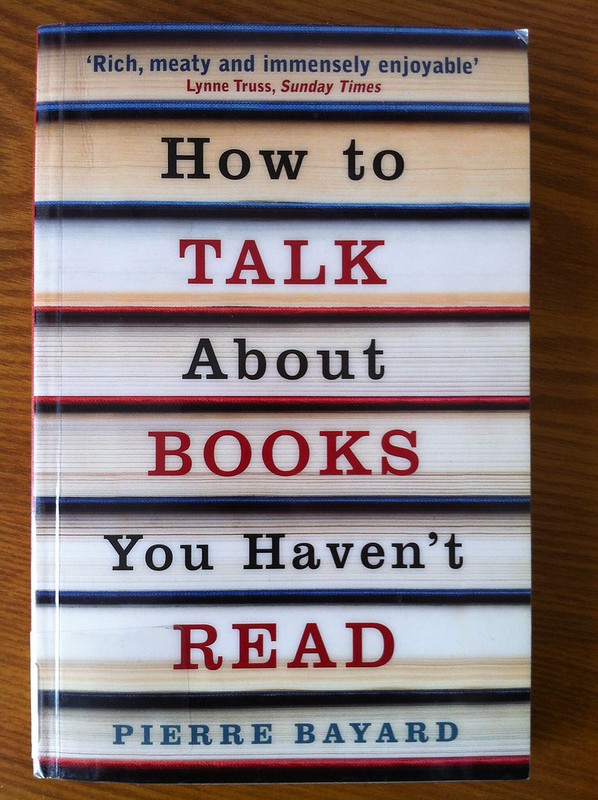
How To Talk About Books You Haven't Read

Comment parler des livres que l'on n'a pas lus?

I first came across this book whilst browsing in the 027 and 028 sections of the library. I chuckled at the rather provocative title, but didn't pick it up to investigate further. However, just a short while after, I was reading Cyburbia where this book was mentioned, so on a subsequent trip to the library I decided to check it out. How To Talk About Books You Haven't Read was a bestseller in France when it came out in 2007. The author Pierre Bayard is a professor of literature and says, as such, he often talks about books he hasn't read! Despite the provocative title and Monsieur Bayard's tongue-in-cheek style, this book was fascinating  and dealt with really quite profound themes. In chapters such as: 
  • Books You Have Forgotten.
  • Encounters With The Writer.
  • Not Being Ashamed.
  • Imposing Your Ideas.
The author discusses: how we interact with texts, the importance of our own opinions and interpretations, whether a book you have read but subsequently forgotten, is really still a book you have read and other facets of our relationship towards literature which warrant contemplation. I loved his final comments of chapter 9, Not Being Ashamed,
"To speak without shame about books we haven't read, we would thus do well to free ourselves of the oppressive image of cultural literacy without gaps, as transmitted and imposed by family and school, for we can strive toward this image for a lifetime without ever managing to coincide with it. Truth destined for others is less important than truthfulness to ourselves, something attainable only by those who free themselves from the obligation to seem cultivated, which tyrannizes us from within and prevents us from being ourselves."
Renaissance man could have read, and read closely, the literary canon of his day, but the modern reader would struggle to find the time to read everything available to us now. Bearing this in mind, I enjoyed Bayard's comment on not being ashamed as a rally call to read what you want rather than reading for cultivation.

The Author's Name Begins With N.

Bayard's book also inspired me to play with my approach to books a little bit. In Chapter 11, Inventing Books, Soseki's novel, Kusamakura is described. In this story, a painter retreats to a quiet hotel on a mountainside to paint. One day his landlady's daughter enters his room and finds him reading a book. She asks the painter what he is reading and he says that he doesn't know. The girl is surprised, so the painter describes his approach to reading, "I open the book at random as though it were a game of chance, and I read the page that ends up in front of me, and that's what is interesting."

Today, at the library, I decided to give this method of reading a try. I went to the L-Q section of the fiction stacks and hovered around the N section. I closed my eyes, reached down to one of the lower shelves and selected a book. I opened the book at random and discovered that this 'game' was not so simple after all. The first book I chose had the author's name at the top of the right hand page so I returned the book and decided to try again starting from the top shelf. This time when I opened the book (it fell open at page 149) there was no indication of the author's name, so I proceeded to read the right hand side page. I have a feeling that the book I read was not a comedy, but it really did make me giggle. Page 149 opens in the middle of a dramatic scene and as I had not read the preceding pages the drama seemed really over-the-top and consequently very amusing. From reading just one page I think the main character's name is Zac. Zac has committed a crime/ fallen foul of the law as he refers to community service, although he seems to be the hero/good guy of the story. I don't know who Mobz or Uncle Fidelis are and I don't know why Zac is at the airport or where he is going.


Page 149 of book X by author N-.
I am not sure whether I am going to extend this 'game' in some way (return to the library to find the book and   read reviews about it once I know the title and author, or, maybe, read the whole book) or just enjoy inventing the story for myself.

Have you approached books in any unorthodox ways? If so, why and did you learn anything from these experiments?

Friday, 22 February 2013

Why I Write - George Orwell


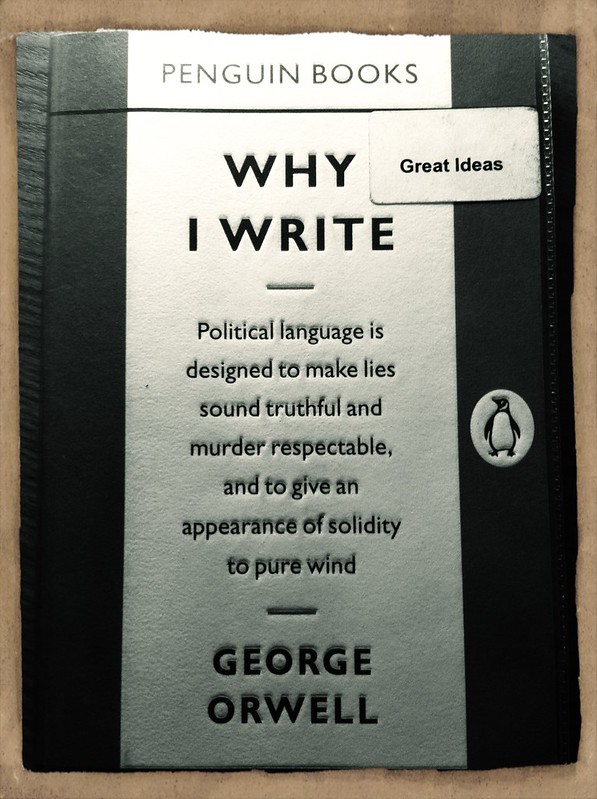
Published as part of Penguin's Great Ideas series, this book includes four of Orwell's essays published between 1931 and 1946: Why I Write, The Lion and The Unicorn: Socialism And The English Genius, A Hanging, and Politics And The English Language. 

The essay I most enjoyed was Politics And The English Language, which featured my favourite quotation. I am obviously not the only person who thinks it's great as Penguin chose an abridged version for the front cover,
"Political language - and with variations this is true of all political parties, from Conservatives to Anarchists - is designed to make lies sound truthful and murder respectable, and to give an appearance of solidity to pure wind."
This essay also contains Orwell's six rules for the clear expression of thought in prose, which is often quoted in How-to-Write-for-Magazines-type manuals:

i. Never use a metaphor, simile or other figure of speech which you are used to seeing in print.
ii. Never use a long word where a short one will do.
iii. If it is possible to cut a word out, always cut it out.
iv. Never use the passive where you can use the active.
v. Never use a foreign phrase, a scientific word or a jargon word if you can think of an everyday English equivalent.
vi. Break any of these rules sooner than say anything outright barbarous.

The longest essay in the collection is the one about English socialism and politics. The essay was written during World War II and deals with the need for political change at home and the necessity of managing the empire and fighting the war. I always thought that three was the magic number, but it seems that Orwell favoured six, as he includes another six point programme here. This time his six points are intended to transform Britain into a social democracy. They are as follows:

1.Nationalization of land, mines, railways, banks and major industries.
2. Limitation of incomes, on such a scale that the highest tax-free income in Britain does not exceed the lowest by more than ten to one.
3. Reform of the educational system along democratic lines.
4. Immediate Dominion status for India, with power to secede when the war is over.
5. Formation of an Imperial General Council, in which the coloured peoples are to be represented.
6. Declaration of formal alliance with China, Abyssinia and all other victims of the Fascist powers.

Sitting here in 2013, I found Orwell's assessment of society in Britain and his plans for political justice rather sad and naive. Nationalisation: that's history! Privatisation is the in-thing now (unless you're talking about pumping public money into the banks). According to the 2011/12 figures, our current education system fails just over 40% of teenagers. Only 58% of young people leave school with 5 or more GCSE passes at A-C. What do those who have failed do in the information age? As for income parity: the rich are getting richer and the poor are getting poorer. In some ways it seems that our lives and the wider world have changed so much since Orwell wrote this piece, but in other ways nothing has changed at all.


Monday, 18 February 2013

Cyburbia


James Harkin describes his 2009 book, Cyburbia: the dangerous idea that's changing how we live and who we are, as the unauthorised biography of cybernetics and its related discipline, network theory. Although cybernetics is a multidisciplinary field, Harkin defines it through Norbert Weiner's understanding as, 'the study of messages as a means of controlling machinery and society'. In the context of the digital age, this is understood as a closed information loop involving us, our computers and the internet.

Norbert Weiner (1894 - 1964), a mathematician at MIT features prominently in the book, along with Marshall McLuhan (media theorist and author of The Medium is the Massage: an inventory of effects, 1967) and Stewart Brand (writer and 60s counter-culture and tech industry thinker).

I found the section about Stewart Brand and the Whole Earth Catalog extremely interesting. The idea that cybernetics made the leap from its initial military applications to a societal role through being co-opted by American hippies involved in counter-culture is pretty, well, far-out. Those involved in the counter-culture thought that technology would play a major role in building the kind of society that they craved. Technological advances had the ability to remove the elite and hierarchy from communication making it peer-to-peer and truly egalitarian.

James Harkin brings the seventy year old story of cybernetics full circle in chapter 9, with a discussion of network theory and the use of new technologies in the military. He goes into quite a lot of detail about the 250 million dollar Millennium Challenge played out by the US military in 2002, which was designed to prove the necessity of technology in the theatre of war, although it seemed that these war games actually proved that all the high tech gadgets in the world could not assure victory.

My reading enjoyment was somewhat marred by annoying typos, e.g. 'give' instead of 'given', 'One the one hand' instead of, 'on the one hand', etc. The text could have done with closer editing in addition to proof reading as, unfortunately, not all the errors were simple typos. On page 18, in reference to the Nazi bombing of London, it says, 'the most advanced German bombers flew over their targets at speeds above three thousand miles per hour and at altitudes as high as thirty thousand feet', this should read 300 mph. I know the Third Reich was militarily advanced, but 3,000 mph is around Mach 4!


I found Nicholas Carr's effort much more enjoyable to read, not only was it written in an accessible journalistic style, it also dealt with subjects of more interest to me personally: the history of writing, printing, ebooks and hypertext, neuroscience and lots about Google.

I was interested to discover that both books, The Shallows and Cyburbia, received rather unfavourable reviews, in particular, from the Guardian Newspaper. As a lay reader, who is not a computer science, or tech industry expert, I found both books worth a read and the reviews that slated them so critical they bordered on conceit. Just because I am reading non-fiction it doesn't mean that I am dealing with fact. I may not have agreed with every hypothesis put forward in these books, but I certainly came across ideas and assertions worthy of further contemplation and research. Each book left me with ideas to debate and discuss with friends and with a reading list to explore.

Thursday, 7 February 2013

The Library at Night


"Siempre imaginé que el Paraíso sería algún tipo de biblioteca." 
"I have always imagined that paradise will be a kind of library."  
Jorge Luis Borges (writer and essayist. He was also Directory of the National Library of Argentina for eighteen years even though, by then, he had lost his sight.)


Alberto Manguel's 2008 book, The Library at Night is a real treat for people who enjoy books about books. In fifteen chapters, with titles such as, 'The Library as Myth', 'The Library as Power', 'The Library as Identity', Manguel explores libraries, taking in: history, memoir, politics, categorisation and classification, and imagination.

Although not a history book, as such, The Library at Night, features many fascinating facts about the history of specific libraries, The Library of Alexandria, The Warburg Library, and the creation of the British Library, for example.

I particularly enjoyed reading about the history of classification, including, of course, Melvil Dewey and his decimals, alphabetisation, and early classification methods from third century China. In the Imperial Library, books were classified under four broad categories: canonical or classical texts, works of history, philosophical works and miscellaneous items. Books in each category were bound in a specific colour: green for classics, red for history, blue for philosophy and grey for miscellaneous. I like the idea of ordering books by subject area but also bestowing an aesthetic harmony on the library through blocks of one specific colour (As a child, I spent many an enjoyable hour organising my books by physical properties (all paperbacks with white spines in one group, all hardbacks together, all the picture books together etc.).

Monday, 7 January 2013

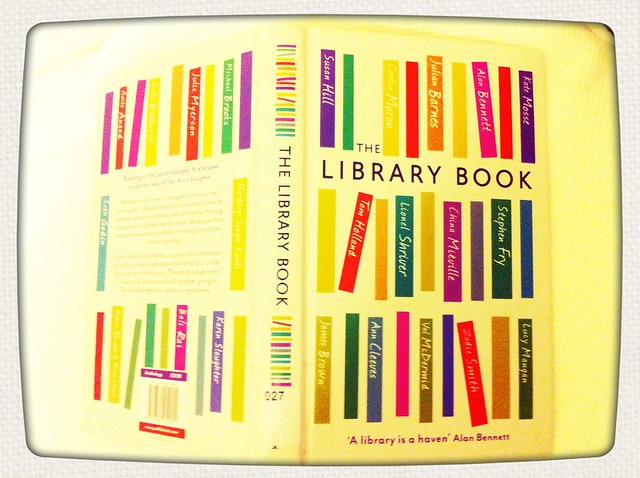
The Library Book

Editor: Rebecca Gray. Profile Books Ltd, London, 2012.

Contributors: James Brown, Anita Anand, Julian Barnes, Hardeep Singh Kohli, Lucy Mangan, Alan Bennet, Seth Godin, Val McDermid, Lionel Shriver, Stephen Fry, Bella Bathurst, China Mieville, Caitlin Moran, Tom Holland, Susan Hill, Michael Brooks, Bali Rai, Ann Cleeves, Julie Myerson, Nicky Wire, Zadie Smith, Kate Mosse, Karin Slaughter, Miranda McKearney.


This anthology is an easy and enjoyable read for any library lover. At just a few pages per essay, memoir or short story it can be read in a day or dipped into at leisure.

My favourite work was Julian Barnes'  Fahrenheit 451 inspired "The Defence of the Book". Barnes' timely satire is set in a dystopian England in a not too distant digital future, where books no longer have any value. The Defence of the Book are a rebel group of white-haired activists who seek to protect the nation's remaining libraries from the destructive forces of the coalition.

The other essays which I particularly enjoyed were Hardeep Singh Kohli's "The Punk and Langside Library" and Caitlin Moran's "Alma Mater".

Monday, 31 December 2012

Best Book 2012


I've read a lot of enjoyable and informative books this year, both fiction and non-fiction. When it came to thinking about my favourite though, Alex Bellos' book was a stand-out winner. This is one of the few books I actually bought this year rather than borrowed from the library. I was browsing in the popular science section of WHSmith and happened to pick up this book - I think I was attracted by the distinctive white and red cover (well done marketing people!). After reading the contents and a few pages of the first chapter I decided that it was a bit unreasonable to actively avoid the 510 - 519 section of the library and that maybe I was missing out.

After the pain of school maths with the accompanying fear of failure and feeling like a failure; I haven't read about, or even thought about, maths since the 1990s. But, on this occasion, the Daily Telegraph are right, reading this book "will leave you hooked on numbers". The most interesting sections of the book for me dealt with: the numerical abilities of animals, innate mathematical abilities of humans, the 12 base number system or 'dozenal', the golden ratio and vedic mathematics.

Sunday, 23 December 2012

Everything is Miscellaneous


David Weinberger's book is dedicated "To the Librarians" and will be enjoyed by anyone with an interest in information and how the digital revolution challenges the traditional understanding of categorisation and cataloguing. The author employs an easy to read style (he even throws in a couple of jokes per chapter - laugh out loud ones, at that!) and at just 233 pages (excluding notes) it is suitable for the general reader - like me.

Features

  • First order organisation (the physical task of ordering objects - placing books on a shelf, clothes in a drawer, second order organisation (creating a card catalogue to find the physical location of your collection) and third order organisation (digital organisation which removes the physical limitations of second order organisation).
  • Melvil Dewey - the creation and current challenges of the Dewey Decimal system.
  • Digital order - tagging.
  • The internet and citizen control of knowledge.
The prologue and first chapter are available to read for free on the book's website, which also features interesting discussions about the issues raised in the text.