Wednesday, 13 March 2013

The Library File Goes to the West Midlands

Part Two: Solihull

Although only 9 miles from Birmingham, the pleasant town of Solihull feels a world away - it feels middle class, calm and small-townish. The large modern shopping mall, in the bustling centre of the town, had the most interesting interior I've seen in such a building. There were art deco style lamp posts with wrap-around leather benches at the bottom for resting on and curved fretwork ceilings with recessed lighting. The interior embellishments were subtle, but once I started to notice them I could see how nicely designed the mall was.

Although there are plenty of older buildings in the town (Solihull escaped the WWII bombing raids which destroyed parts of Birmingham and Coventry), the library, which shares a building with the arts centre, is housed in a utilitarian seventies block.

Solihull Arts Complex and Central Library, opened 1978.
Despite the slightly depressing exterior (not helped by the grey, drizzling day and bare, winter trees), Solihull Central Library is, what I would call, a 'proper' library. When you enter on the ground floor you come across an enquiry desk, and then the room opens out displaying the circulating collection of: fiction, non-fiction, CDs and DVDs, a large sheet music collection and an extensive collection of language learning resources. The children's library is situated in a large area to the right of the main area. The reference library, local history section, national careers library and special resources for the visually impaired are located on the first floor along with plenty of PCs. 
The ground floor lending library.
For a first time visitor, the library is very easy to use and it is also very well stocked. I was pleased to see such a comprehensive reference section, and I went a bit mad photographing encyclopaedias and dictionaries: they had everything from encyclopaedias of military uniforms to reference works on oriental rugs and English goldsmiths.

Oxford Dictionary of National Biography.

Tuesday, 12 March 2013

Woman + Noteworthy = Actress


"Mummy, I don't want to be an actress or a singer!"

I came across this display for International Women's Day in one of the Newcastle branch libraries. I like displays in libraries -  it makes a change to see the front covers of books displayed prominently, and it's nice to use a collection of books to commemorate events of regional, national or international importance.

However, I was rather shocked by the books that had been chosen for the display as the majority of them were biographies of actresses, with two popular singers (Rihanna and Jessie J) and a royal. Where were the politicians, the explorers, the craftswomen, etc? As the library (which will remain nameless) is a branch library, I understand that they are limited in their choices by a small circulating stock. But, with a bit of imagination  it is possible to make a more fitting display from the titles readily available in that particular library. From the books I noticed on the shelves whilst browsing and from a subsequent search of the catalogue, I have made my own virtual display:

  • Eleanor of Aquitaine: Queen of France, Queen of England  - Ralph V. Turner
  • Liberty Belles: Six Women and the French Revolution - Lucy Moore
  • Off the Beaten Track: Three Centuries of Women Travellers - Dea Birkett
  • Singled Out: How Two Million Women Survived Without Men After the First World War - Virginia Nicholson
  • Women of the War Years: Women in Britain 1939 to 1945 - Janice Anderson
  • Ingrid: A Personal Biography - Charlotte Chandler
  • The Catherine Cookson Companion - Cliff Goodwin
  • Agatha Christie: The Finished Portrait - Andrew Norman
  • Moral Disorder - Margaret Atwood
  • Letter to my Daughter - Maya Angelou
  • What Makes Women Happy - Fay Weldon
  • Backwards in High Heels: The Impossible Art of Being Female - Sarah Vine and Tania Kindersley
  • Tate Women Artists - Alicia Foster
  • Open Secret: The Autobiography of the Former Director-General of MI5 - Stella Rimington
This is not my castaway choice of women's writing/ writing about women, as I could only choose titles that were available in that library. I tried to make the list varied and populist, and I think these titles would celebrate the spirit of International Women's Day much more than the current uninspiring display.

Monday, 11 March 2013

Zoladdiction - The Emile Zola Reading Challenge


Zoladdiction, hosted by Fanda at Fanda Classiclit and O at Delaisse, will be my first ever reading challenge! As I have never attempted a reading challenge before, I thought I would start small. The event takes place throughout the month of April and you can join Zoladdiction  at varying commitment levels:
  • 1st level: Maheude (reading 1 book)
  • 2nd level: Gervaise (reading 2-3 books)
  • 3rd level: Nana (reading 4 books or more)
I don't know why I haven't read any Zola before. My favourite literary movement is realism and as far as I can tell, naturalism, of which Zola was the master, is an extension of that movement. Bearing this in mind, I have a feeling that Zola is going to be absolutely fantastic - I hope I haven't set my expectations too high!

I intend to attempt the second level: Gervaise, and read two books. I have already managed to find a second-hand copy of Germinal and if I can't find a copy of The Masterpiece I will borrow it from the library.

Sunday, 10 March 2013

Short Story Sunday - Truman Capote

Truman Capote - The Complete Stories (Penguin Modern Classics)

This collection contains twenty short stories. They are ordered chronologically and span the years 1943 to 1982, with over half of them being written in the 1940s.

I have not read any of Truman Capote's other works, but I don't think I can say that I approached the stories with a completely open mind. I read very few modern classics (with a particular lack of interest in titles from the 40s and 50s) as I generally prefer novels from either the late nineteenth century or the 1990s and 2000s.

I started at the beginning and planned to read the whole collection chronologically. By the time I had finished A Tree of Night (the eighth story), I gave up and decided to flick forwards to dip into a few more stories from the later years.

Many of the first several stories focused on female characters and had an eerie atmosphere, but when the stories came to an end, I was left thinking, "Well, what was that all about?". In The Walls Are Cold a disturbed, teenage coquette throws a strop; in Miriam a lonely widow is scared; in A Tree of Night a young, female college student is frightened by some ne'er-do-wells on a train. The only story which I enjoyed in the first section was Jug of Silver which is about a poor, young boy called Appleseed and his attempts to win a guess-how-many competition of a jar filled with nickels and dimes.

I'm glad that I didn't just give up with this collection, as the autobiographical stories: A Christmas Memory, The Thanksgiving Visitor and One Christmas were worth wading through the strange stories about perturbed and disturbed women.

Truman Capote's parents divorced when he was very young and he was sent to live with elderly, distant relatives of his mother's in rural Alabama. He becomes great friends with one of the elderly relatives, Miss Sook.
"I am seven; she is sixty-something. We are cousins, very distant ones, and we have lived together -well, as long as I can remember. Other people inhabit the house, relatives; and though they have power over us, and frequently make us cry, we are not, on the whole, too much aware of them. We are each other's best friend. She calls me Buddy, in memory of a boy who was formerly her best friend. The other Buddy died in the 1880s, when she was still a child. She is still a child."
The descriptions of rural life in the South during the Great Depression are very vivid and although the relationship between Miss Sook and Buddy may be a bit saccharine sweet for some, I thought these three stories were really beautiful. Unlike the rest of the collection, they had plot, moral and well-crafted characterisation.


Saturday, 9 March 2013

The Library File Goes to the West Midlands

Part One - Birmingham

I have just returned from three, library-themed days in the West Midlands. I spent a day in Birmingham visiting the Central Library and I saw the outside of the new Library of Birmingham. As you can see from the pictures, the weather was very bad and during the odd occasion when it wasn't raining, it was really foggy.


The Central Library opened in 1974 and certainly looks of the era! I would describe it as modernist, but I'm sure others might refer to it as 'industrial' or 'depressing'. Despite the somewhat severe exterior, the inside used to be a warm and inviting place to visit. I once spent a memorable afternoon in the children's section reading Michael Morpugo's Private Peaceful and hoping that no one would notice the tears rolling down my cheeks. 

The remains of the lending library: half empty shelves, self-service machines and  not much else.

The services at the Central Library are currently being wound down in preparation for the opening of the new Library of Birmingham in September. The children's section, or Centre for the Child, as it used to be known, is now closed and the lending library is a paltry affair on the first floor. The other four floors of the library (arts, social sciences, sciences, archives, black history) are all closed; however, the IT services remain open and there are still plenty of study places available. The Central Library will close forever at 5pm on 29th June 2013.


The new Library of Birmingham
The new Library of Birmingham building looks a little bit like a huge ship moored in between the existing buildings in Centenary Square. It was designed by the Dutch architectural firm, Mecanoo and it is, by no means, their craziest design for a library building. Mecanoo were also commissioned to design the library at Delft Institute of Technology in the Netherlands, which looks like a cross between a grassy knoll and a strange, new age temple.


The new website for the library is now up and running and provides plenty of information about the building and the services it will offer. It seems that the golden rotunda (I think I'll refer to it as the funnel of the 'ship') is designed to hold the city's Shakespeare collection of 43,000 books and the original Shakespeare Memorial Room (designed 1882) has been moved in its entirety and rebuilt in the rotunda. I hope I get a chance to visit Birmingham again, some time after September, as the Shakespeare Memorial Room sounds marvellous.

Sunday, 3 March 2013

Short Story Sunday - George Saunders

Welcome to the first installment of Short Story Sunday!


When I first thought about increasing my reading of short fiction I envisaged reading one collection per month. I thought I would read a couple of stories per week as a fifteen minute Book at Bedtime and then post a review here on my blog. After reading my first collection, which I devoured in one afternoon, I decided to make Short Story Sunday a weekly event.

The Tenth of December


"An astoundingly tuned voice - graceful, dark, authentic and funny" - Thomas Pynchon.
 Tenth of December, released in the UK in January 2013, contains ten short stories of varying lengths (the shortest just shy of two pages and the longest sixty pages).

Of the six snippets of critical praise on the back of the dust jacket, four refer to Saunders and/or his stories as funny. I don't know what book these, black-hound humour, litterateurs read, but I didn't find any of the tales in Saunders' new collection funny. Dark, caustic, wonderfully crafted and eminently readable -  but funny? No. The 'voice' Saunders gives his characters is, in many of the stories, witty (for example, Ted in My Chivalric Fiasco), but the situations in which his characters find themselves are so grave and depressing that these comical turns of phrase don't really succeed in lightening the stories.

Being completely new to George Saunders, I wasn't sure what to expect when I read the first story: Victory Lap. I was slightly lost initially until I realised that the strange writing style of the first few pages represented the thoughts of a flighty, teenage girl. By the time her neighbour and fellow teenager, Kyle Boot, appeared on the page (with corresponding change in style), I was really impressed by Saunders' ability to craft dialogue which expressed the teen sound (female and male) so clearly. By the end of the collection I learnt that Saunders' can create an authentic voice for all his characters: young, middle-aged, middle class, poor, etc.

The stories I enjoyed reading most were: Victory Lap, The Semplica Girl Diaries and Tenth of December. Many of the stories in Saunders' collection are set in a not too distant dystopian future, where there are drugs to make you depressed (Darkenfloxx), or enable you to get into a role (KnightLyfe), living-human decorative features for your front garden (Semplica Girls), and mysterious consumer gadgets (MiiVoxMAX). Victory Lap and Tenth of December, however, are both set in a recognisable present.

The Semplica Girl Diaries is written in epistolary form: the forty year old protagonist gets a new journal and decides to write every evening for a year to leave a record of his life for his descendants. Although the main character is male, there is something very Bridget Jonesy about this story as he blunders through life trying to keep his family afloat financially. I felt increasingly frustrated by his inability to break free of the demands of the community to which he wished his family firmly belonged, i.e. wealthy consumers, and as pointed out by his father-in-law, he did seem to lack moral fibre. These financial ups and downs acted as a vehicle for the heart of the story which was the relationship between the parents and children and how the actions of one of the children ultimately showed the mettle of the father figure.

There are two stories in the collection which I really didn't like: Home and Escape from Spiderhead. My dislike is not in any way predicated on the quality of the writing; in fact, these are the two stories that I just can't get out of my head (maybe this makes them the best in the collection...). The reason I didn't like them is that the subject matter was just too dark and depressing for me.

The themes that immediately jumped out at me when I finished reading the collection and, perhaps, they seemed so clear because I read the whole thing in one afternoon were:

  • the unlikely hero.
  • the front yard as metaphor - I know it sounds strange, but it appeared in: Victory Lap, Sticks, Puppy, The Semplica Girl Diaries and Home.
What did you think of this collection?

If you would like to take part in Short Story Sunday, post a review about your chosen short story or collection on your own blog and then leave a link in the comments section.


Friday, 1 March 2013

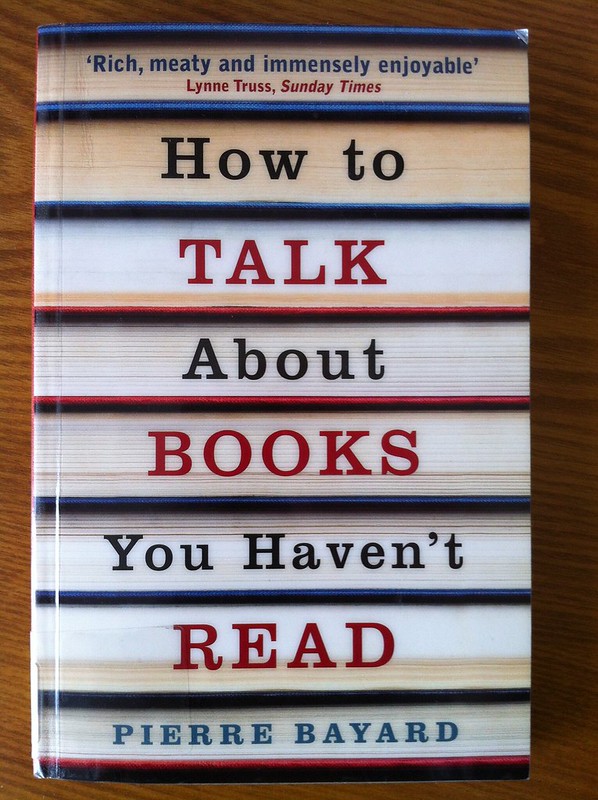
How To Talk About Books You Haven't Read

Comment parler des livres que l'on n'a pas lus?

I first came across this book whilst browsing in the 027 and 028 sections of the library. I chuckled at the rather provocative title, but didn't pick it up to investigate further. However, just a short while after, I was reading Cyburbia where this book was mentioned, so on a subsequent trip to the library I decided to check it out. How To Talk About Books You Haven't Read was a bestseller in France when it came out in 2007. The author Pierre Bayard is a professor of literature and says, as such, he often talks about books he hasn't read! Despite the provocative title and Monsieur Bayard's tongue-in-cheek style, this book was fascinating  and dealt with really quite profound themes. In chapters such as: 
  • Books You Have Forgotten.
  • Encounters With The Writer.
  • Not Being Ashamed.
  • Imposing Your Ideas.
The author discusses: how we interact with texts, the importance of our own opinions and interpretations, whether a book you have read but subsequently forgotten, is really still a book you have read and other facets of our relationship towards literature which warrant contemplation. I loved his final comments of chapter 9, Not Being Ashamed,
"To speak without shame about books we haven't read, we would thus do well to free ourselves of the oppressive image of cultural literacy without gaps, as transmitted and imposed by family and school, for we can strive toward this image for a lifetime without ever managing to coincide with it. Truth destined for others is less important than truthfulness to ourselves, something attainable only by those who free themselves from the obligation to seem cultivated, which tyrannizes us from within and prevents us from being ourselves."
Renaissance man could have read, and read closely, the literary canon of his day, but the modern reader would struggle to find the time to read everything available to us now. Bearing this in mind, I enjoyed Bayard's comment on not being ashamed as a rally call to read what you want rather than reading for cultivation.

The Author's Name Begins With N.

Bayard's book also inspired me to play with my approach to books a little bit. In Chapter 11, Inventing Books, Soseki's novel, Kusamakura is described. In this story, a painter retreats to a quiet hotel on a mountainside to paint. One day his landlady's daughter enters his room and finds him reading a book. She asks the painter what he is reading and he says that he doesn't know. The girl is surprised, so the painter describes his approach to reading, "I open the book at random as though it were a game of chance, and I read the page that ends up in front of me, and that's what is interesting."

Today, at the library, I decided to give this method of reading a try. I went to the L-Q section of the fiction stacks and hovered around the N section. I closed my eyes, reached down to one of the lower shelves and selected a book. I opened the book at random and discovered that this 'game' was not so simple after all. The first book I chose had the author's name at the top of the right hand page so I returned the book and decided to try again starting from the top shelf. This time when I opened the book (it fell open at page 149) there was no indication of the author's name, so I proceeded to read the right hand side page. I have a feeling that the book I read was not a comedy, but it really did make me giggle. Page 149 opens in the middle of a dramatic scene and as I had not read the preceding pages the drama seemed really over-the-top and consequently very amusing. From reading just one page I think the main character's name is Zac. Zac has committed a crime/ fallen foul of the law as he refers to community service, although he seems to be the hero/good guy of the story. I don't know who Mobz or Uncle Fidelis are and I don't know why Zac is at the airport or where he is going.


Page 149 of book X by author N-.
I am not sure whether I am going to extend this 'game' in some way (return to the library to find the book and   read reviews about it once I know the title and author, or, maybe, read the whole book) or just enjoy inventing the story for myself.

Have you approached books in any unorthodox ways? If so, why and did you learn anything from these experiments?