Thursday, 31 January 2013

High Heaton Library

The distinctive round library at High Heaton opened in 1968. It was closed in 2007 as part of Newcastle Council's £40 million PFI libraries improvement scheme and subsequently demolished, rebuilt and reopened in its current incarnation in September 2008. Designed by Ryder Architecture, who also designed City Library, the exterior is aesthetically pleasing. The building is now comma-shaped rather than completely round.

It is quite shocking to think that High Heaton is one of the branch libraries that may face closure in the 2013 library cuts. If the Council closes the library (lauded at its opening as 'state of the art' and 'ultra-modern') it may well have to be demolished. Even if it is demolished, the Council will still have to pay a £7,500 annual charge to cover the cost of the original PFI finance deal.


Tuesday, 29 January 2013

Books versus Ereaders.


The Library File does not own an ereader. Among the benefits outlined by ereader owners are the low price of ebooks and the solution to the never-ending problem of storage.

Storage

The Library File's household moves location every six months to a year and boxes of books make up quite a large volume of the removal. The idea of storing 1,400 books on a slimline tablet weighing less than 170g is the most attractive element of an ereader for me.

Cost

Based on the books I read last year I decided to do a price comparison between print books and ereaders. To purchase all the books I read last year in print versions I would have paid £272.10 (does not include transport costs to visit a bookshop as during most of last year I lived within walking distance of three bookshops).

To start using an ereader and buy ebooks would have cost £308.46. This extra cost is mainly accrued through the requirement to purchase an ereader (if I wanted an ereader I would buy a £69 Kindle), but even without the Kindle the total cost was not as cheap as I was expecting. On investigation, it turns out that many of the non-fiction titles I read are really not that much cheaper as an ebook. Furthermore, I would still have bought some print books as many of the books I read are not currently available in digital versions. The total price does not take into account electricity costs for charging the reader, but I don't think this outgoing would be particularly noticeable in today's gadget filled homes.

Environmental Concerns

Book publishing is a resource-hungry and polluting industry. By the time the latest bestseller reaches the bookshelves of your local bookshop trees have been cut down to make the paper, inks have been made and energy used to print and bind the books, fuel has been burnt to transport the books from the distributor to the shops and, if unsuccessful in the marketplace, more fuel will be burnt in returning the books to the publisher and then pulping them.

That doesn't sound very good, but are ereaders more eco-friendly than books?

Like all electronic gadgets, ereaders are constructed, in part, from non-renewable rare earth elements (REEs) which must be mined, there are also energy costs associated with use (electricity required for charging) and issues regarding e-waste management. 
Most of the articles I have read about the environmental impact of ereaders neglect to mention data storage  as an issue (although Cloud computing has many advantages, I do take issue with the nomenclature. To have data stored 'in the Cloud' makes it sound like an ethereal fairy which weighs nothing and leaves no trace). Data (including Amazon's ebooks) is ultimately stored at a server farm, some of which use as much power as a small city. A Greenpeace report released last year savaged both Amazon and Apple for using coal-fired power to feed their energy-hungry server farms.

For the time being I will continue borrowing books from the library: I don't have to spend hundreds of pounds a year feeding my reading habit, I don't have to worry about lack of storage and a library book is possibly the most environmentally friendly way to read.

Long live the library!

Monday, 28 January 2013

The Library: a powerful and nefarious institution

Don't worry! It's only science-fiction.


The frightening library in question is The People's Topical Libary of Philip K. Dick's 1967 novel, Counter-Clock World. 

The basic premise of the novel is that time has started to run backwards in what is called the 'Hobart Phase'. People re-awaken in their graves and are 'old-born'. As time regresses they grow younger until they become children, then babies, eventually entering a suitable womb as a foetus with the foetus finally splitting into a separate egg and sperm.

The Library is charged with controlling information that is no longer relevant as the authors of the works are now younger than when they originally composed them. Douglas Appleford, the librarian of Section B of the Library says that the job of the library is not "to study and/or memorize data; it is to expunge it."

The story centres around the re-birth of Anarch Peak, a controversial religious leader. In a racially and religiously partitioned United States, the Library fears that his re-birth will fan sectarian violence so they seek to find him and kill him. In its quest to 'maintain order in society' the Library makes use of child assassins (former adult employees of the Library who have regressed to childhood) and has a council of "erads" who undertake psychological assessments on Library captives akin to a visit from a Harry Potter Dementor.

In future novels, we humans always seem to have the luxury of getting around in air-cars. Counter-Clock World is no different in this respect, although I was amused by the juxtaposition of the still unrealised dream of air-car travel and the almost defunct technology of a tape recorder.

The time-reversal plot device was a little tricky to get used: the action in the story clearly progresses (cause and effect) with the lifestyle oddities of the Hobart Phase (disgorging food instead of ingesting, blowing smoke into cigarette ends and then placing the un-smoked cigarette in a packet) seeming like a forced reminder of the fact that time is actually travelling backwards.


Thursday, 17 January 2013

Jesmond Library

Jesmond is one of the unfortunate libraries in Newcastle council's cross hairs. Today, I decided to brave the icy pavements and slip along to take some photographs.

The entrance of the library taken from across the street.
I like the sixties building and I'm glad that it wasn't modernised on the outside. The library underwent a £40,000 interior refurbishment in 2011 including automatic doors, a new public toilet, a community meeting room and £5,000 worth of new stock.

In May 2011 Nick Forbes, the Leader of Newcastle Council, said,
“I am delighted that the residents of Jesmond will soon be able to use their newly refurbished library. The building is a valuable resource and these improvements have helped provide better access for everyone and will generate more community use. The refurbishment complements the distinctive architecture of the building, bringing it up to date with the latest technology.”
In 2013, it seems that Jesmond Library is no longer "a valuable resource".


The library was quite busy whilst I was there. There were a few people using the computers, someone reading the papers and many people coming and going, borrowing and returning items.

The interior of the library with the fiction titles shelved on the curved Eastern wall of the building.


Tuesday, 15 January 2013

A Bookless Library

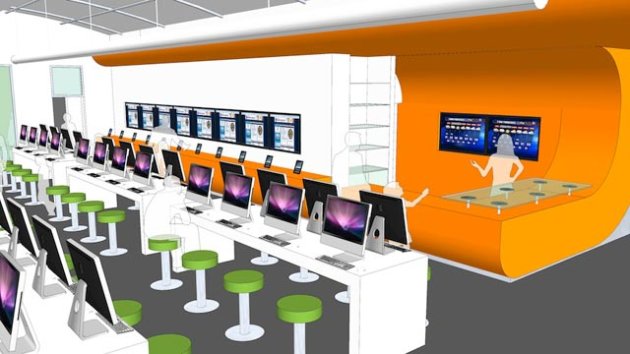
Artist's rendering of the no-book library. From ABC News

First bookless library to open in Texas.

BiblioTech, the first bookless public library is due to open this autumn. The institution will have 100 e-readers available for circulation (apparently theft is not an issue - at the end of the two week loan period the reader will run out of power and be more or less useless), they will have e-readers available for children on site, as well as 50 computer terminals, 25 laptops and 25 tablets. BiblioTech will start with a collection of 10,000 titles intending to add more as time goes on. Library users who have their own e-reader will also be able to borrow books without visiting the library through the online catalogue and a pin number. Thankfully, this new initiative will not replace a traditional library, it will be an additional service for the citizens of Bexar Country, Texas.

Definitions.

I'm not sure if we need to redefine the library of the 21st century, or if we should coin new terms to describe such initiatives as BiblioTech. For most people, I think, the base meaning of the word library is: a room filled with books. Libraries often have periodicals, archives, DVDs, and computing and printing services attached but these are often seen as extra services.

 Maybe we should name libraries like BiblioTech, information lending libraries, or ILL for short, which happens to be how I feel about the concept.

Saturday, 12 January 2013

What is a library?

"A library in the middle of a community is a cross between an emergency exit, a life raft and a festival. They are cathedrals of the mind; hospitals of the soul; theme parks of the imagination. On a cold, rainy island, they are the only sheltered public spaces where you are not a consumer, but a citizen instead. A human with a brain and a heart and a desire to be uplifted, rather than a customer with a credit card and an inchoate "need" for "stuff"."
Alma Mater. Caitlin Moran.

Friday, 11 January 2013

Gateshead Central Library

The main entrance of Gateshead Central Library.

If my local library ends up closing then Gateshead Central Library will become my local library. If my local library ends up a community-run library then the Central Library will probably still end up being the library I visit most because the community-run libraries will not be able to order in books from the core circulating stock.

Although not as big or well-stocked as Newcastle City Library, Gateshead is a warm, well-lit, clean and welcoming place.

The Central Library with the new extension on the right and the main entrance on the left.


Comfy chairs and sofas in the fiction section.